GLOBAL ENGLISH WRITING MASTERCLASS
by Pravin Salkade
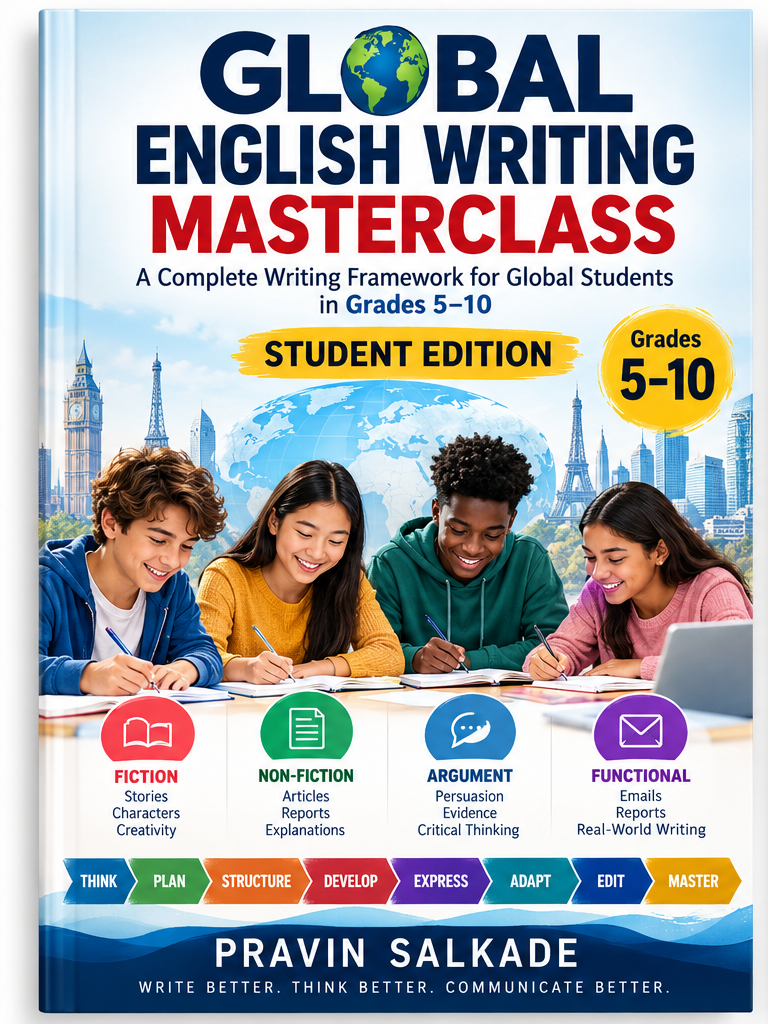
<p><strong>GLOBAL ENGLISH WRITING MASTERCLASS</strong> is a comprehensive writing-development programme for students in <strong>Grades 5–10</strong>. It is designed to take learners from writing their first clear sentences and paragraphs to producing confident, sophisticated <strong>fiction, non-fiction, arguments and real-world communication</strong>.</p><p>Unlike a book focused only on grammar, essay formats or examination techniques, the Student Edition treats <strong>writing as a thinking skill</strong>. The goal is to help students become independent writers who can decide <strong>what to say, how to organise it, how to develop it, how to express it and how to improve it</strong>.</p>Core promise<p><strong>Write Better. Think Better. Communicate Better.</strong></p><p>The book follows the progression:</p><p><strong>THINK → PLAN → STRUCTURE → DEVELOP → EXPRESS → ADAPT → EDIT → MASTER</strong></p><p>This is consistent with the wider writing-development approach used in strong contemporary writing programmes, which increasingly combine sentence development, vocabulary, writing models, guided practice and revision rather than treating writing as a single final-product exercise. <a href="https://ngl.cengage.com/sites/greatwritingseries/new-and-updated-features?utm_source=chatgpt.com">ngl.cengage.com</a></p>The Four Writing Worlds<p>Students learn to move confidently between four major purposes of writing:</p><ol start="1"><li><strong>FICTION</strong> — stories, characters, scenes, dialogue and narrative</li><li><strong>NON-FICTION</strong> — explanations, articles, reports, reviews and summaries</li><li><strong>ARGUMENT</strong> — opinions, discussion, persuasion, evidence and counterarguments</li><li><strong>FUNCTIONAL</strong> — emails, speeches and practical communication</li></ol><p>The important idea is that <strong>purpose determines structure</strong>.</p>The Four PhasesPART I — Building the Foundation<p><strong>Units 1–10</strong></p><p>Students learn:</p><ul><li>What makes writing effective</li><li>The difference between speaking and writing</li><li>Words → sentences → paragraphs</li><li>The <strong>SEE Framework</strong></li><li>Topic sentences</li><li>Explanation and development</li><li>Examples</li><li>Complete paragraphs</li><li>The Writing Ladder</li></ul><p>The basic paragraph model is:</p><p><strong>Statement → Explanation → Example → Result</strong></p><p>The emphasis is on <strong>clear thinking before sophisticated language</strong>.</p>PART II — Control Your Language<p><strong>Units 11–21</strong></p><p>Students develop language control through:</p><ul><li>Precision vocabulary</li><li>Strong verbs</li><li>Collocations</li><li>Sentence variety</li><li>Simple, compound and complex sentences</li><li>Relative clauses</li><li>Conditionals</li><li>Modifiers</li><li>Grammar editing</li><li>Vocabulary and sentence upgrading</li></ul><p>The central principle is:</p><p><strong>Precision is more valuable than impressive-looking vocabulary.</strong></p><p>Students learn to transform writing through:</p><p><strong>Precision → Development → Variety</strong></p>PART III — Write for Different Purposes<p><strong>Units 22–40</strong></p><p>This is where students move from isolated skills to complete pieces of writing.</p><p>They learn:</p><ul><li>Essays</li><li>Opinion writing</li><li>Agree/disagree writing</li><li>Compare and contrast</li><li>Cause and effect</li><li>Problem and solution</li><li>Discussion writing</li><li>Fiction</li><li>Descriptive writing</li><li>Articles</li><li>Reviews</li><li>Emails</li><li>Reports</li><li>Summary writing</li><li>Personal reflection</li><li>Persuasive writing</li><li>Speech writing</li><li>Introductions and conclusions</li><li>Complete writing workshops</li></ul><p>Students discover that the same basic writing skills can be adapted to completely different situations.</p><p>For example:</p><p><strong>Article:</strong><br>HOOK → CONTEXT → KEY IDEAS → EXAMPLES → INSIGHT → TAKEAWAY</p><p><strong>Report:</strong><br>PURPOSE → FINDINGS → ANALYSIS → RECOMMENDATIONS</p><p><strong>Argument:</strong><br>CLAIM → REASON → EXPLANATION → EVIDENCE → COUNTERPOINT → JUDGEMENT</p><p><strong>Story:</strong><br>SETTING → TRIGGER → OBSTACLE → RESPONSE → YIELD</p>PART IV — Become an Advanced Global Writer<p><strong>Units 41–56</strong></p><p>The final phase develops higher-level independent writing.</p><p>Students learn:</p><ul><li>Planning before writing</li><li>Evidence and reasoning</li><li>Counterarguments</li><li>Concession</li><li>Cohesion without overusing linking words</li><li>Tone and register</li><li>Formal, academic and professional style</li><li>Data and visual description</li><li>Editing</li><li>Transforming intermediate writing into advanced writing</li><li>Global writing challenges</li><li>Fiction development</li><li>Non-fiction development</li><li>Synthesis</li><li>Portfolio building</li><li>Self-assessment</li></ul><p>The advanced transformation model is:</p><p><strong>Precision → Development → Nuance</strong></p><p>The book teaches that <strong>advanced writing does not mean complicated writing</strong>. It means writing where every important word, sentence and idea has a purpose.</p>The Book's Unique Learning Architecture<p>One of the strongest features is <strong>progressive reinforcement</strong>.</p><p>For example, the SEE framework begins simply:</p><p><strong>Statement → Explanation → Example</strong></p><p>Later it develops into:</p><p><strong>Claim → Reason → Development → Example → Result</strong></p><p>And eventually becomes:</p><p><strong>Claim → Reasoning → Evidence → Counterpoint → Judgement</strong></p><p>Similarly, fiction progresses from:</p><p><strong>Setting + Character + Action</strong></p><p>to:</p><p><strong>Character motivation + consequence + theme + controlled narrative voice</strong></p><p>This means students are not learning disconnected writing tricks. They are <strong>building the same core abilities at increasing levels of sophistication</strong>.</p>Grade 5–10 Progression<p>The book is designed as a <strong>six-year development pathway</strong>, rather than six completely separate books.</p>Grades 5–6<p>Foundation:</p><ul><li>sentences</li><li>paragraphs</li><li>description</li><li>simple stories</li><li>explanations</li><li>basic vocabulary and grammar</li></ul>Grades 7–8<p>Development:</p><ul><li>stronger paragraphs</li><li>sentence variety</li><li>articles</li><li>reviews</li><li>reports</li><li>structured arguments</li><li>narrative development</li></ul>Grades 9–10<p>Advanced school writing:</p><ul><li>essays</li><li>evidence</li><li>analysis</li><li>counterarguments</li><li>formal writing</li><li>synthesis</li><li>data description</li><li>sophisticated fiction and non-fiction</li><li>independent editing</li></ul><p>This makes the book suitable for <strong>mixed-age school programmes, home learning, tutoring and individual progression</strong>, with extension activities for stronger students.</p>Student-Centred Features<p>The book is not simply a collection of explanations.</p><p>Students repeatedly <strong>write, review, revise and transfer</strong> what they learn.</p><p>Key recurring elements include:</p><ul><li><strong>Core Framework</strong></li><li><strong>Writer's Rule</strong></li><li><strong>Think Like a Writer</strong></li><li><strong>Fiction Tool</strong></li><li><strong>Non-Fiction Tool</strong></li><li><strong>Editor's Eye</strong></li><li>Writer's Toolkit</li><li>Practice activities</li><li>Revision Labs</li><li>Transfer Challenges</li><li>Peer/Teacher Checks</li><li>Exit Tickets</li></ul><p>The final portfolio asks students to collect evidence of their development rather than simply finish the book.</p>Final Portfolio<p>Students build a portfolio containing examples such as:</p><ul><li>First paragraph</li><li>Improved paragraph</li><li>Best essay</li><li>Fiction piece</li><li>Non-fiction article</li><li>Formal email</li><li>Data description</li><li>Advanced writing challenge</li><li>Teacher feedback</li><li>Personal reflection</li></ul><p>They also use a <strong>50-point Writing a scorecard</strong> covering areas such as:</p><p><strong>Ideas | Organisation | Development | Vocabulary | Sentence Variety | Grammar | Cohesion | Tone | Evidence/Examples | Editing</strong></p>
Who it's for: Class 5 to 10 students across the globe who want to improve their English Writing Skills
Available internationally through Amazon and selected booksellers. Availability, format and delivery options vary by country.
Part of the Salkade Communication Framework™ — Communication & Test Prep — IELTS, PTE & English shelf.