Many students believe that good reading means understanding every word.
So when they encounter an unfamiliar word, they stop.
They translate it.
They reread the sentence.
Then they continue.
A few lines later, another difficult word appears.
The cycle begins again.
The result?
They may understand individual words but completely miss the meaning of the passage.
That is why effective reading requires more than vocabulary.
It requires a framework for understanding.
What does it really mean to understand what you read?
Understanding means identifying how the information works together.
A strong reader asks:
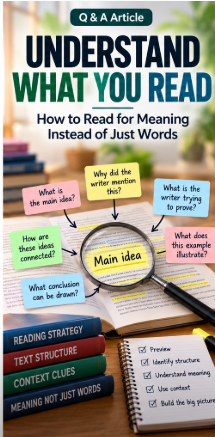
What is the main idea?
Why did the writer mention this?
What is the writer trying to prove?
What does this example illustrate?
How are these ideas connected?
What conclusion can reasonably be drawn?
Reading is therefore not simply word recognition.
It is meaningful construction.
Why is knowing every word not enough?
Consider a sentence containing ten words.
You may know the meaning of all ten words individually.
But you can still misunderstand the sentence if you fail to understand:
contrast
cause and effect
comparison
opinion
purpose
reference
implication
For example, words such as however, although, therefore, despite, consequently and while can dramatically change the relationship between ideas.
A reader who focuses only on vocabulary may miss that relationship.
How can you understand difficult passages more effectively?
Start with structure.
Instead of asking:
“What does every word mean?”
Ask:
“What is this paragraph doing?”
Is it:
introducing an idea?
providing evidence?
giving an example?
presenting a contrast?
explaining a cause?
describing an effect?
challenging an earlier claim?
reaching a conclusion?
Once you understand the function of the paragraph, individual sentences become easier to interpret.
What should you do when you encounter an unfamiliar word?
Don't automatically stop.
First, examine the context.
Ask:
What meaning would make sense here?
Look at the words before and after it.
Then consider the paragraph's overall message.
Sometimes the surrounding information provides enough clues to understand the role of the unfamiliar word—even if you don't know its exact dictionary definition.
How does this help in IELTS, PTE, TOEFL and Cambridge exams?
Reading examinations frequently test more than vocabulary.
They test whether you can locate information, identify relationships, understand purpose, interpret meaning and distinguish between similar options.
This means a candidate can have strong vocabulary and still choose the wrong answer.
The problem may not be English knowledge.
It may be reading strategy.
What is the most important reading habit?
After reading a paragraph, pause and ask:
“What was the writer doing here?”
Not:
“What words did I see?”
That small change moves you from word-level reading to meaning-level reading.
What is the central lesson of Understand What You Read?
Good readers don't simply collect words.
They build a mental map of the text.
They understand the relationship between ideas.
They notice what the writer says—and what the writer is trying to do.
Don't read merely to recognise words.
Read to understand the thinking behind them.
That is the difference between reading a passage and actually understanding it.