Pravin Salkade | Global IELTS & PTE Expert | Author | Educator
People rarely search the internet by asking, “What is the complete theory of English communication?”
They ask much simpler—and much more important—questions:
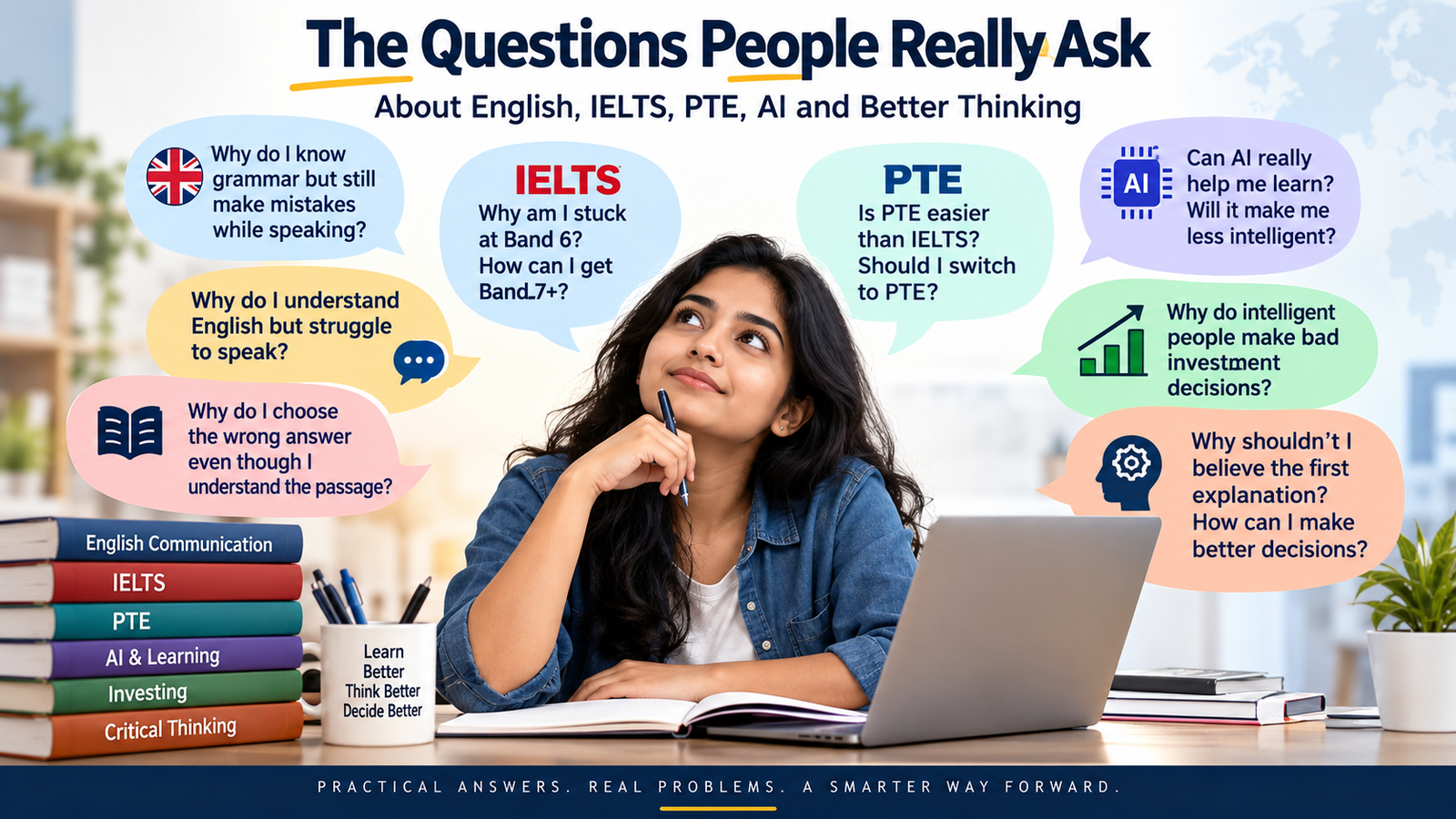
Why do I understand English but still make mistakes?
Why am I stuck at IELTS Band 6?
Is PTE really easier than IELTS?
Why do I know the answer but choose the wrong option?
Can AI help me learn without making me dependent on it?
Why do intelligent people make bad decisions?
These questions reveal something important.
People don't necessarily need more information.
They need better explanations of the problems they are actually facing.
This article brings together some of the most common questions learners, students, professionals and decision-makers ask—and provides practical answers.
1. Why do I know English grammar but still make mistakes while speaking?
Because knowing a grammar rule and using it automatically are two different skills.
Grammar knowledge is often passive. Speaking requires rapid retrieval.
You have to choose the words, grammar, pronunciation and sentence structure almost simultaneously.
What should you do?
Don't spend all your time studying more rules.
Take one rule you already know and use it repeatedly in real sentences.
For example:
I have worked here for five years.
Then create ten variations:
I have lived here for five years.
I have studied English for five years.
I have known him for five years.
The objective is to make correct English increasingly automatic.
Related book: GRAMMAR THAT WORKS
2. Why do I understand English but struggle to speak?
Reading and listening give you recognition.
Speaking requires retrieval.
You may recognise a word immediately when you see it but fail to produce it when somebody asks you a question.
The solution
Turn passive vocabulary into active vocabulary.
Read something.
Close the book.
Explain the idea aloud.
Record yourself.
Then listen.
This simple cycle—read → close → recall → speak → review—can be more useful than repeatedly reading vocabulary lists.
Related book: Spoken English Mastery
3. Why do I translate from my mother tongue before speaking English?
Translation becomes a habit when you construct English sentences through your first language.
Instead of translating complete sentences, begin learning useful English expressions as units.
For example:
It depends on...
As far as I know...
One possible reason is...
What I mean is...
These expressions reduce the mental effort required to construct every sentence from scratch.
Related book: English Conversation Mastery
IELTS Questions People Really Ask4. Why am I stuck at IELTS Band 6 in Writing?
Many candidates assume that their problem is vocabulary or grammar.
Sometimes it is.
But another major problem is idea development.
A candidate may have a good point but fail to explain:
why it is true
how it works
what its consequences are
What example supports it
A strong paragraph is not simply a collection of sentences.
It is a developed idea.
A useful pattern
Point → Explanation → Example → Consequence
This helps turn a short idea into a meaningful paragraph.
Related book: IELTS Writing Task 2: Never Run Out of Ideas
5. Should I memorise IELTS essays?
Memorising complete essays is risky.
The exact question may be different from the one you prepared.
A better approach is to memorise thinking frameworks, useful language and ways of developing ideas.
Recent IELTS discussions also emphasise that topics may recur while the exact wording of questions can change.
Learn the system, not the answer.
That is the difference between preparation and memorisation.
Related book: IELTS Writing Task 2: The 4-Stage Band 7+ Blueprint
6. Why do I run out of ideas in IELTS Writing Task 2?
Usually because candidates think they need extraordinary ideas.
They don't.
They need relevant ideas that can be developed logically.
When you see a question, ask:
Why?
What is the result?
Who is affected?
Can I give an example?
What happens if the situation continues?
Five simple questions can generate considerably more material than trying to invent a brilliant argument.
Related book: IELTS Writing Task 2: Never Run Out of Ideas
7. How can I get Band 7+ in IELTS Speaking?
Don't try to sound like a textbook.
Don't try to use difficult vocabulary in every sentence.
Instead, aim for:
clear ideas + natural language + development + fluency
For example, instead of giving a one-sentence answer:
I like travelling because it is interesting.
Develop it:
I enjoy travelling mainly because it gives me a break from my routine. I also get to experience different cultures, and that usually changes the way I look at everyday life.
The second answer provides more language and more thought.
Related book: IELTS Speaking Band 7+: Sound Confident, Not Rehearsed
IELTS or PTE?8. Is PTE easier than IELTS?
This is probably one of the most common questions—and the answer is:
It depends.
IELTS and PTE assess the same broad four skills, but their formats are substantially different. IELTS uses human examiners for Speaking and Writing, whereas PTE is computer-delivered and uses automated scoring.
Recent learner discussions show exactly this difference: some candidates find PTE easier because of its structured computer-based format, while others find IELTS more natural because they prefer a human speaking interview.
The better question is:
Which test suits my strengths better?
If you are comfortable speaking into a microphone, working quickly and following structured computer tasks, PTE may suit you.
If you prefer interacting with a human examiner and feel more comfortable with traditional reading and writing tasks, IELTS may feel more natural.
Best strategy
Don't decide only because somebody says:
PTE is easier.
Take a realistic mock test for both.
Then compare your performance with your required score.
9. Should I switch from IELTS to PTE?
Possibly.
But don't switch simply because you are frustrated with IELTS.
First identify why you are not getting the required score.
If you repeatedly score well in three IELTS skills but struggle with writing, ask whether changing tests actually addresses the underlying weakness.
Recent candidates considering the switch commonly ask about preparation time, task differences, speaking, spelling, timing and whether the new format will improve their score.
The important question is not
Which exam is easier?
It is:
Which exam gives me the clearest path to my required score?
Reading Questions10. Why do I understand the passage but still choose the wrong answer?
Because understanding the passage and evaluating an option are different skills.
Test questions often contain attractive distractors.
A familiar word may appear in an option, making it look correct.
But the option may not answer the question precisely.
Use this rule:
Don't choose an answer because it sounds familiar.
Choose it because you can prove it from the text.
This principle applies particularly well to IELTS, PTE and other reading examinations.
Related book: STOP CHOOSING THE WRONG ANSWER
11. Why do familiar words sometimes lead me to the wrong answer?
Because familiarity creates confidence.
Suppose the passage says:
The project was delayed because of financial difficulties.
An option says:
The project was cancelled because it was expensive.
The words financial and expensive may appear related.
But the meaning is different.
The project was delayed, not necessarily cancelled.
The test is checking whether you understand the relationship—not whether you recognise a word.
Related book: STOP CHOOSING THE WRONG ANSWER
PTE Questions12. Why do I find PTE difficult even though my English is good?
Because English proficiency and test proficiency are not identical.
PTE requires familiarity with specific task types, timing and computer-based interaction.
Recent candidates specifically report difficulty understanding the format even when they are otherwise comfortable with English.
Therefore:
First learn the test.
Then practise the test.
Then improve the English skills required by the test.
Trying to solve all three problems simultaneously can create unnecessary confusion.
Related book: PTE Reading & Writing Decoded
13. How long should I prepare for PTE?
There is no universal number of days.
Your preparation time depends on:
current English level
required score
previous test experience
familiarity with PTE tasks
weakest skills
time available each day
Someone with strong English but no knowledge of the PTE format may need a very different preparation plan from someone with weak English but extensive test experience.
Start with diagnosis.
Don't start with the calendar.
Related book: PTE Core Communication Decoded
English Writing Questions14. Why is my English grammatically correct but still unnatural?
Because grammar is only one part of natural communication.
Natural English also depends on:
word combinations
collocations
sentence patterns
register
context
For example, knowing individual words does not automatically mean you know which words normally occur together.
That is why vocabulary should be learned in patterns, not isolated lists.
Related book: IELTS COLLOCATIONS THAT WORK
15. Why do students use complicated words incorrectly?
Because they sometimes believe:
Difficult vocabulary = advanced English.
It doesn't.
The best word is the word that communicates the intended meaning accurately and naturally.
A simple, accurate word is better than an impressive, incorrect word.
Better principle:
Precision before complexity.
Related books: GLOBAL ENGLISH WRITING MASTERCLASS editions
AI Questions16. Can AI actually help students learn?
Yes—but how AI is used matters.
AI can explain a difficult concept, generate practice questions, provide alternative explanations and help students identify gaps.
But if the student simply asks AI for every answer, the technology can remove the very thinking process the student needs to develop.
Better method
Try → struggle → ask AI → analyse → try again
Don't begin with:
Ask AI → copy → submit
AI should become a learning partner, not a replacement for learning.
Related book: AI SMART STUDENT
17. Is using AI for studying cheating?
Not necessarily.
The answer depends on the purpose and the rules of the institution.
Using AI to understand a difficult concept is fundamentally different from submitting AI-generated work as your own when that is prohibited.
The important question is:
Who is doing the thinking?
If AI does everything, the student may receive an answer without developing the underlying skill.
Related book: AI SMART STUDENT
18. Can AI make people less intelligent?
AI itself does not make people less intelligent.
But unthinking dependence can weaken skills.
If you stop remembering, analysing, writing and solving problems because AI always does them for you, you may gradually lose practice in those abilities.
A simple rule:
Use AI to extend your thinking—not to replace it.
Related book: AI SMART PROFESSIONAL
Investing Questions19. Why do intelligent people make bad investment decisions?
Because intelligence does not eliminate emotion.
People can be influenced by:
fear
greed
overconfidence
confirmation bias
herd behaviour
loss aversion
A person can be highly intelligent and still make an emotionally driven decision.
The challenge is not merely becoming smarter.
It is recognising when your thinking is being distorted.
Related book: SMART MINDS, BAD CHOICES
20. Should I follow investment advice from social media?
Treat it as information—not instruction.
Before acting on an investment idea, ask:
What is the thesis?
What evidence supports it?
What could make it wrong?
What is my downside?
Does it fit my objectives?
If you cannot answer these questions, you probably don't understand the investment well enough to act.
Related books: The Complete Indian Investor / CRYPTO FOR THE CAUTIOUS INVESTOR
Critical-Thinking Questions21. Why shouldn't I believe the first explanation I hear?
Because the first explanation is simply the first explanation.
It is not automatically the correct one.
When something happens, ask:
What else could explain this?
That one question can protect you from premature conclusions.
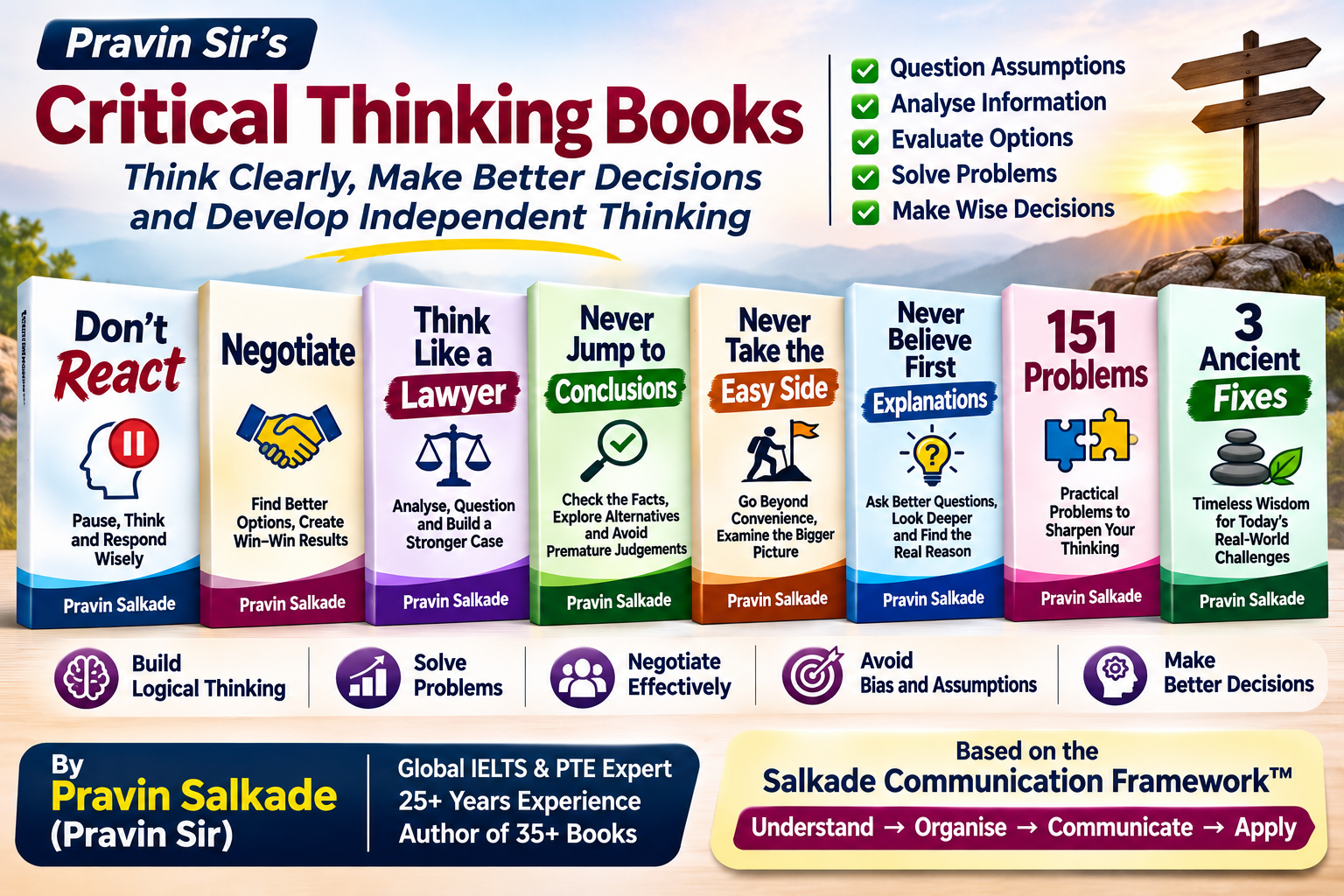
Related book: Never Believe the First Explanation
22. Why do people jump to conclusions?
Because quick conclusions reduce uncertainty.
The mind prefers a clear story to an unresolved problem.
But a satisfying explanation can still be wrong.
Try separating three things:
What I know.
What I think.
What I am assuming.
This simple separation improves reasoning.
Related book: Never Jump to Conclusions
23. Why isn't the easiest answer always the best answer?
Because easy answers often remove discomfort rather than solve the problem.
The easiest option may be attractive because it requires less effort, less uncertainty or less confrontation.
Before choosing it, ask:
Am I choosing this because it is right—or because it is comfortable?
Related book: Never Take The Easy Side
24. How can I make better decisions?
You don't need a complicated system for every decision.
Start with five questions:
What exactly am I deciding?
What do I know?
What am I assuming?
What alternatives exist?
What could go wrong?
Then decide.
This is especially useful when emotions are high.
Related book: Think like a Lawyer
25. How can I stop reacting emotionally?
Create a pause.
The pause is powerful because it separates the event from your response.
Instead of:
Something happened → I reacted
try:
Something happened → I paused → I understood → I responded
That small gap can change the quality of a decision.
Related book: DON'T REACT. NEGOTIATE.
The Bigger LessonAcross English learning, IELTS, PTE, AI, investing and critical thinking, the same problem appears again and again.
People often ask:
What is the trick?
But the better question is:
What is the underlying problem?
A student struggling with IELTS Writing may not need more vocabulary.
A PTE candidate struggling with scores may not need another shortcut.
A student using AI may not need another AI tool.
An investor losing money may not need another prediction.
A person making poor decisions may not need more information.
They may need to understand the problem behind the problem.
That is the purpose of this collection of questions.
A Simple Framework for Better LearningWhenever you face a problem, try this:
1. Identify the real question.
What exactly am I trying to solve?
2. Identify the assumption.
What am I taking for granted?
3. Look for evidence.
What do I actually know?
4. Consider alternatives.
What else could be true?
5. Choose a practical action.
What can I do differently today?
6. Review the result.
What did I learn?
This framework works far beyond examinations.
It works for communication, education, career decisions, AI, investing and everyday life.
Explore the Salkade Books & Coaching EcosystemThese