Learning English is not just about memorising vocabulary or studying grammar rules.
Many learners know hundreds of English words and understand grammar, but still hesitate when they have to speak. The real challenge is often using English naturally, quickly and confidently in real situations.
Here are 20 important questions about spoken English, grammar and fluency.
1. How Can I Speak English Fluently Without Memorising Sentences?
Fluency does not mean memorising hundreds of ready-made sentences.
Instead, learn patterns, expressions and ideas that you can adapt.
For example, instead of memorising:
I would like to know more about this subject.
Learn the pattern:
I would like to know more about the topic.
You can then create:
I would like to know more about the course.
I would like to know more about the job.
I would like to know more about the process.
The goal is to become capable of creating sentences, not reproducing memorised ones.
2. How Can I Improve My English Speaking at Home?
You can improve speaking without attending a class every day.
Create a simple daily routine:
10 minutes listening → 10 minutes speaking → 10 minutes vocabulary → 10 minutes conversation practice.
Talk about familiar topics such as
Your day
Your work
Your family
News
Travel
Food
Technology
Your plans
Record yourself occasionally and listen for:
Hesitation
Repeated words
Grammar mistakes
Pronunciation problems
Unnatural expressions
The most important principle is simple:
Do not wait until your English is perfect before you start speaking.
3. How Can I Stop Translating Hindi to English?
Many Indian learners first think in Hindi and then convert the sentence into English.
This can make speaking slow.
Instead, start connecting situations directly with English.
For example, when you see a door, think:
Open the door.
When you are thirsty:
I need some water.
When you are leaving:
I'll be back soon.
Start with simple thoughts. Gradually, your brain becomes more comfortable processing English without going through Hindi first.
The objective is not to stop using your first language completely. It is to develop the ability to think directly in English when speaking English.
4. Why Do Indians Make These English Mistakes?
Indian English has developed through the influence of Indian languages, education systems and local communication habits.
Some expressions are widely understood in India but may sound unusual or unnatural to international English speakers.
Examples include:
I have a doubt.
I am having two brothers.
Please revert back.
Do one thing.
I am going to my native place.
I passed out in 2020.
Understanding these differences is useful because being understood and sounding natural are not always the same thing.
5. What Are 50 Common English Mistakes Indians Make?
Some frequently heard examples include:
Common Indian EnglishMore natural EnglishI have a doubt.I have a question.I am having two brothers.I have two brothers.Please revert back.Please reply.Discuss the issue.Discuss the issue.Return back.Return.Repeat it again.Repeat it.Do one thing.Here's what you can do.I passed out in 2020.I graduated in 2020.Myself Pravin.I'm Pravin.I know him.I know him.I didn't know.I didn't know.He doesn't know.He doesn't know.She has a car.She has a car.Open the light.Turn on the light.Close the light.Turn off the light.Give an exam.Take an exam.Give me a call back.Call me back.This morning.This morning.Yesterday night.Last night.What is your good name?What's your name?The solution is not to feel embarrassed about these mistakes. Notice them, understand them and replace them through practice.
6. What Is the Difference Between Indian English and Natural English?
Indian English is not simply "bad English".
It is a variety of English influenced by India's multilingual environment.
However, some expressions that are common in Indian English may sound less natural in international communication.
For example:
Indian usage: I have a doubt.
Natural alternative: I have a question.
The purpose of learning natural international English is not to erase your identity or accent.
It is to increase your clarity, flexibility and ability to communicate with different English speakers.
7. How Can I Think in English Instead of Translating?
Start small.
Don't attempt to think about complicated subjects in English immediately.
Begin with simple internal sentences:
I'm getting ready.
I need to call him.
It's raining outside.
I should leave now.
What should I do next?
Then gradually move to opinions:
I don't agree with this idea because...
The main problem is...
One advantage is...
This develops a direct connection between thought and English expression.
8. How Can I Improve My English Vocabulary for Speaking?
You don't need to memorise thousands of difficult words.
For speaking, focus on useful vocabulary and collocations.
Instead of learning only:
decision
learn:
Make a decision
reach a decision
difficult decision
final decision
Instead of learning only:
opportunity
learn:
Create an opportunity
Take an opportunity
a great opportunity
a career opportunity
Vocabulary becomes much more useful when you learn words in context.
9. How Can I Speak English Confidently at Work?
Workplace confidence comes from being able to perform common communication tasks.
Practise situations such as the following:
Introducing yourself
Giving an update
Asking for clarification
Disagreeing politely
Making a suggestion
Explaining a problem
Participating in meetings
Speaking to customers
Giving a presentation
For example:
Instead of: I don't understand.
Try:
Could you clarify that point?
Instead of:
You are wrong.
Try:
I see it slightly differently.
Good workplace English is not just about grammar. It is also about clarity, tone and professional communication.
10. How Can I Start a Conversation in English?
Starting a conversation does not require complicated English.
Use simple openings:
How's your day going?
How do you know everyone here?
What do you do?
Have you been here before?
How was your weekend?
What brings you here?
How did you get interested in this?
Then listen carefully to the answer.
A good conversation is not a speech. It is an exchange.
Ask → listen → respond → ask a related question.
11. How Can I Continue a Conversation in English?
Many learners can start a conversation but don't know how to continue it.
Use follow-up questions.
If someone says:
I went to Dubai last month.
Don't simply say:
Oh, nice.
Continue with:
How was the trip?
or:
What did you enjoy most there?
Useful conversation expressions include:
Really?
That's interesting.
What happened next?
How did you feel about it?
What made you choose that?
Tell me more about that.
What was the best part?
Good conversation skills depend heavily on listening and responding, not just speaking.
12. What Are 50 Useful English Small-Talk Sentences?
Small talk becomes easier when you have useful conversational patterns.
Examples include:
How's everything going?
How have you been?
How was your weekend?
What have you been up to?
Have you been busy lately?
How's work going?
What do you do?
Where are you from?
Have you been here before?
How did you get here?
What brings you here?
What do you think of the place?
Is this your first time here?
What kind of work do you do?
What do you usually do on weekends?
Are you travelling for work or pleasure?
How was your trip?
How long are you staying?
What did you enjoy most?
Have you tried the food here?
What do you recommend?
That's interesting.
Really? Tell me more.
I completely understand.
I know what you mean.
That's a good point.
I hadn't thought about it that way.
What do you think?
How did that happen?
What happened next?
That sounds interesting.
That must have been difficult.
I'm glad to hear that.
That's great news.
What are you working on?
How did you get into that?
What made you choose it?
Do you enjoy it?
What are your plans for the weekend?
Have you watched anything good recently?
What kind of music do you like?
Do you travel often?
What's your favourite place?
Where would you like to travel next?
What do you usually do after work?
Are you learning anything new?
What are you interested in?
It's been great talking to you.
Let's catch up again.
Have a great day!
The key is not to memorise all 50. Choose a few that fit your personality and practise using them naturally.
13. How Can I Speak English in Interviews?
Interview English requires clarity, structure and confidence.
Prepare answers around common areas:
Tell me about yourself.
Why do you want this job?
What are your strengths?
What is your weakness?
Why should we hire you?
Tell me about a challenge you faced.
Where do you see yourself in five years?
Don't memorise complete answers word for word.
Instead, prepare:
Point → Example → Result
This allows you to answer naturally while maintaining structure.
14. How Can I Improve My English Pronunciation?
Good pronunciation is not about copying a particular accent.
The priority should be:
clarity + intelligibility + appropriate stress and rhythm.
Work on:
Word stress
Sentence stress
Difficult consonant sounds
Vowel sounds
Connected speech
Final sounds
Record yourself saying a sentence and compare it with a reliable English model.
Also practise speaking slowly and clearly before trying to speak faster.
Speed without clarity does not create good communication.
15. Why Doesn't Knowing Grammar Make Me Fluent?
Grammar knowledge and speaking ability are different skills.
You may know that the past perfect is used in a particular situation, but that does not automatically mean you can use it instantly during a conversation.
Fluency requires automaticity.
You need to move from:
Knowing the rule → recognising the pattern → using the pattern automatically.
That requires repeated speaking practice.
Grammar is important.
But grammar knowledge alone does not create fluency.
16. Grammar vs Fluency: What Should I Practise First?
You need both, but your priority depends on your current level.
If you can hardly form sentences, basic grammar should receive more attention.
If your grammar is reasonably good but you hesitate constantly, you probably need more speaking practice.
A useful approach is:
Learn → Practise → Speak → Correct → Repeat
Don't spend months studying grammar without using it.
At the same time, don't ignore repeated grammar mistakes in the name of fluency.
The goal is accurate fluency.
17. What Are 10 English Sentences Indians Commonly Say Incorrectly?
Here are ten common examples:
I have a doubt.
Better: I have a question.I am having two brothers.
Better: I have two brothers.Please revert back.
Better: Please reply.Discuss about the problem.
Better: Discuss the problem.I didn't knew.
Better: I didn't know.He don't know.
Better: He doesn't know.I am knowing him.
Better: I know him.Open the AC.
Better: Turn on the AC.Close the fan.
Better: Turn off the fan.Myself Rahul.
Better: I'm Rahul.
The important point is to understand why the original sentence is problematic rather than simply memorising the correction.
18. What Are 100 Daily English Sentences for Real Conversations?
Daily English improves when you practise sentences connected to situations you actually experience.
Useful areas include:
At home
I'm getting ready.
I'll be there in a minute.
Have you eaten?
I'll do it later.
Where did I put my phone?
At work
I'll check and get back to you.
Could you explain that again?
I'll send it today.
Let's discuss this later.
I agree with your point.
Shopping
How much does this cost?
Do you have another size?
Can I try this?
Do you accept cards?
Is there any discount?
Travel
Where is the nearest station?
How long does it take?
Is this the right bus?
Could you help me with my luggage?
What time does it leave?
Social situations
What have you been doing lately?
That's interesting.
What do you think?
Tell me more.
Let's catch up soon.
Rather than memorising 100 sentences mechanically, practise them in mini-conversations.
19. How Can I Stop Saying I Have a Doubt in English?
This is one of the most common Indian English expressions.
In standard international English, doubt usually refers to uncertainty or lack of belief.
For example:
I have doubts about his explanation.
But when you want to ask for clarification, question is usually more natural.
Instead of:
I have a doubt about this topic.
Say:
I have a question about this topic.
Instead of:
Can I ask one doubt?
Say:
Can I ask a question?
It's a small change, but it can make your English sound more natural.
20. How Can I Speak English Naturally Without Sounding Memorised?
Natural English comes from flexibility, not memorisation.
Learn useful structures, but change them according to the situation.
For example:
I think...
can become:
I think this is a good idea.
I think we should wait.
I think you're right.
I think there's a better option.
Also practise reacting spontaneously.
Listen to a question and give yourself only a few seconds to respond.
Don't aim for a perfect sentence.
Aim for a clear, relevant and natural response.
Over time, your brain becomes faster at converting ideas into English.
Final TakeawayImproving spoken English is not about learning one magical vocabulary list or memorising thousands of sentences.
It is about developing four abilities:
Think → Form → Speak → Respond
Learn useful grammar.
Build practical vocabulary.
Listen to natural English.
Speak regularly.
Notice your mistakes.
Then practise again.
The goal is not to sound like someone else.
The goal is to become a clear, confident and flexible English communicator.
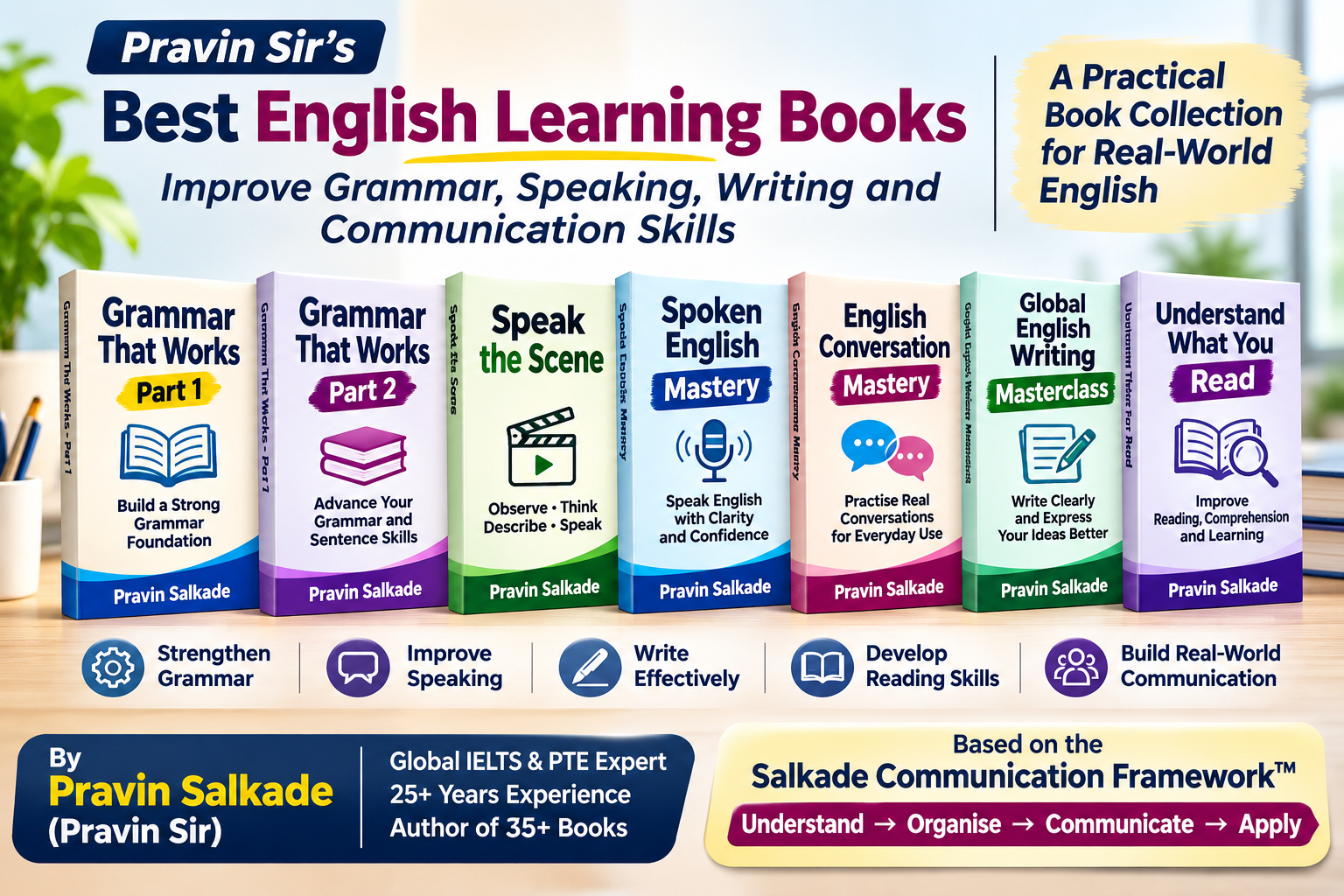
For deeper practice, these topics naturally connect with Spoken English Mastery, Grammar That Works, English Conversation Mastery and Speak the Scene in the Salkade Communication series.