What Is the Salkade Communication Framework™?
Pravin Salkade — English, IELTS, PTE & Communication Expert | Author & Creator of the Salkade Communication Framework™
With 25+ years of experience in English language training, Pravin Salkade has developed a practical approach to English learning and communication that goes beyond memorising grammar rules, vocabulary lists or examination strategies.
This approach is known as the Salkade Communication Framework™.
At its heart is a simple idea:
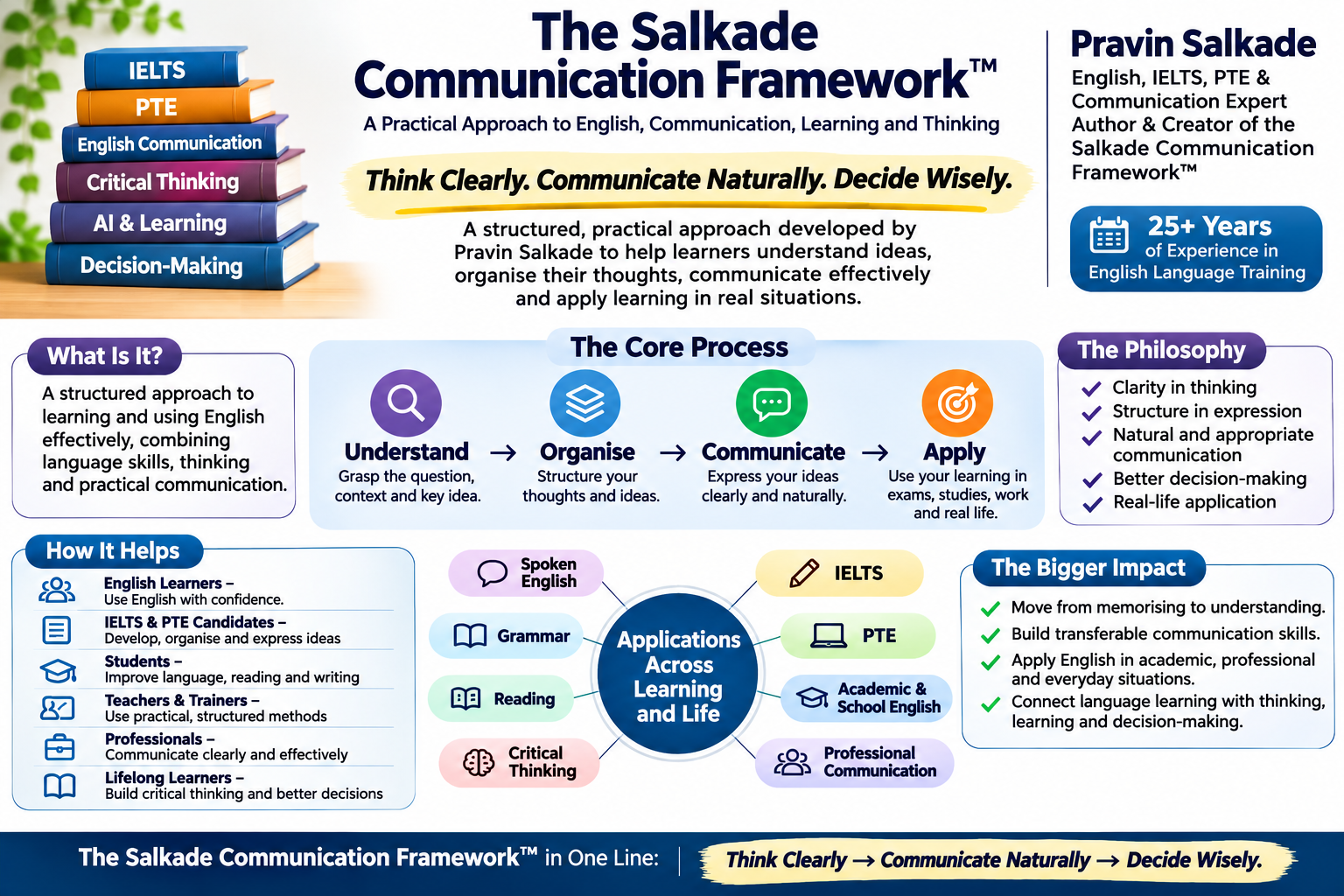
Think clearly. Communicate naturally. Decide wisely.
The framework connects English learning with something deeper: the ability to understand ideas, organise thoughts, express them effectively and use communication confidently in real situations.
---
1. What is the Salkade Communication Framework™?
The Salkade Communication Framework™ is a structured approach to learning and using English effectively.
It focuses on helping learners move through four important stages:
Understand → Organise → Communicate → Apply
Instead of asking learners simply to memorise more English, the framework encourages them to understand what they want to say, organise their thoughts and communicate them appropriately.
This makes the approach useful not only for English learners but also for IELTS and PTE candidates, teachers, professionals, students and independent learners.
---
2. Why was the framework developed?
Many learners study English for years but still hesitate when they have to use it.
They may know grammar rules but struggle to speak.
They may know hundreds of words but cannot organise their ideas.
They may understand a question but cannot develop a clear answer.
They may know an IELTS or PTE strategy but cannot apply it naturally.
The problem is often not simply a lack of English knowledge.
It is a lack of structure.
The Salkade Communication Framework™ attempts to solve this problem by giving learners practical structures that they can repeatedly use.
---
3. What does “Think Clearly, Communicate Naturally, Decide Wisely” mean?
The three-part philosophy represents three connected abilities.
Think Clearly
Before communicating effectively, a person needs to understand the idea.
Clear thinking involves identifying the question, separating important information from unnecessary information and developing a logical response.
Communicate Naturally
Communication should not sound like memorised English.
The objective is to use appropriate vocabulary, grammar, organisation and tone while still sounding natural.
Decide Wisely
Communication is ultimately connected to action.
People use information to make decisions — about education, careers, investments, learning and everyday life.
Therefore, effective communication should support better judgement rather than simply producing fluent sentences.
---
4. How does the framework help English learners?
The framework encourages learners to focus on using English rather than merely studying English.
For example, instead of memorising a list of expressions, a learner can ask:
- What am I trying to communicate?
- Who am I communicating with?
- What is the main idea?
- Which information is important?
- How should I organise my answer?
- What language would communicate this idea naturally?
This changes English learning from a memory exercise into a communication process.
---
5. How is the framework connected to IELTS?
IELTS requires more than English knowledge.
Candidates need to understand questions, generate ideas, organise responses and communicate them clearly.
This is particularly important in IELTS Writing and Speaking.
The Salkade approach therefore uses structured techniques to help candidates develop ideas without making their responses sound artificially memorised.
One example is the SEE the GQ Framework™, designed to help IELTS Writing Task 2 candidates develop and organise ideas.
The broader principle remains the same:
Understand the question → develop the idea → organise the response → communicate clearly.
---
6. How is it useful for IELTS Speaking?
IELTS Speaking requires candidates to communicate spontaneously.
A useful speaking strategy therefore cannot depend entirely on memorised answers.
The Salkade approach combines structure with natural communication.
Learners are encouraged to:
Think → Organise → Speak
This helps them develop answers while maintaining a natural conversational style.
The objective is not to make every candidate sound the same.
The objective is to help candidates communicate their own ideas more effectively.
---
7. How does it apply to PTE?
PTE requires candidates to perform specific language tasks under time constraints.
Here, structure becomes particularly important.
Learners need to understand the task, identify what is required, organise their response and execute it accurately.
The framework therefore complements PTE preparation by encouraging learners to understand the purpose behind a task rather than relying exclusively on mechanical templates.
---
8. Is the Salkade Communication Framework™ only for examination preparation?
No.
IELTS and PTE are important applications, but the philosophy is broader.
The framework can be applied to:
- Spoken English
- Grammar
- Reading
- Writing
- Academic English
- Professional communication
- Teacher training
- Self-study
- School education
- Critical thinking
- Learning and decision-making
The underlying question remains:
Can the learner understand, organise and use information effectively?
---
9. How does it help with Spoken English?
Spoken English is not simply about knowing more words.
Effective speaking requires the ability to:
1. Understand the situation
2. Identify what you want to say
3. Organise your thoughts
4. Choose appropriate language
5. Deliver the message naturally
6. Respond to the other person
This is why practical situations are central to effective spoken-English learning.
Learners should practise conversations they are likely to encounter in real life rather than simply repeat isolated sentences.
---
10. How does the framework approach grammar?
Grammar is treated as a tool for communication rather than an end in itself.
Instead of asking only:
“What is the grammar rule?”
learners can also ask:
“What meaning am I trying to communicate, and which structure communicates it accurately?”
This creates a more practical relationship between grammar and communication.
Grammar becomes something learners use, not merely something they study.
---
11. How does reading fit into the framework?
Reading is also a thinking skill.
A strong reader does not merely recognise words.
A strong reader asks:
- What is the main idea?
- What evidence supports it?
- What is implied?
- What is the writer's purpose?
- What conclusion can reasonably be drawn?
- Is there another possible interpretation?
This creates a bridge between English learning and critical thinking.
---
12. How does critical thinking connect with communication?
Clear communication depends partly on clear thinking.
If a person has not understood an issue properly, even excellent vocabulary may not produce a strong response.
Critical thinking helps learners distinguish between:
Observation → Interpretation → Evidence → Inference → Conclusion
This way of thinking can improve academic writing, professional communication, reading comprehension and everyday decision-making.
---
13. What makes the framework different?
The framework is not based on the idea that every learner needs to memorise the same answers.
Instead, it emphasises transferable structures.
A learner who understands a structure can apply it to a new question.
That distinction is important.
Memorisation can help with short-term performance.
Understanding can support long-term ability.
The goal of the Salkade Communication Framework™ is therefore to create repeatable learning and communication processes.
---
14. How does it help teachers and trainers?
The framework can also be useful from the teacher's perspective.
Teachers need more than content.
They need ways to help students:
- understand difficult ideas
- organise responses
- identify errors
- practise effectively
- transfer classroom learning to real situations
A structured methodology can make teaching more consistent while still allowing teachers to adapt activities to different learners.
---
15. What is the role of books in the framework?
Books provide a way to extend learning beyond the classroom.
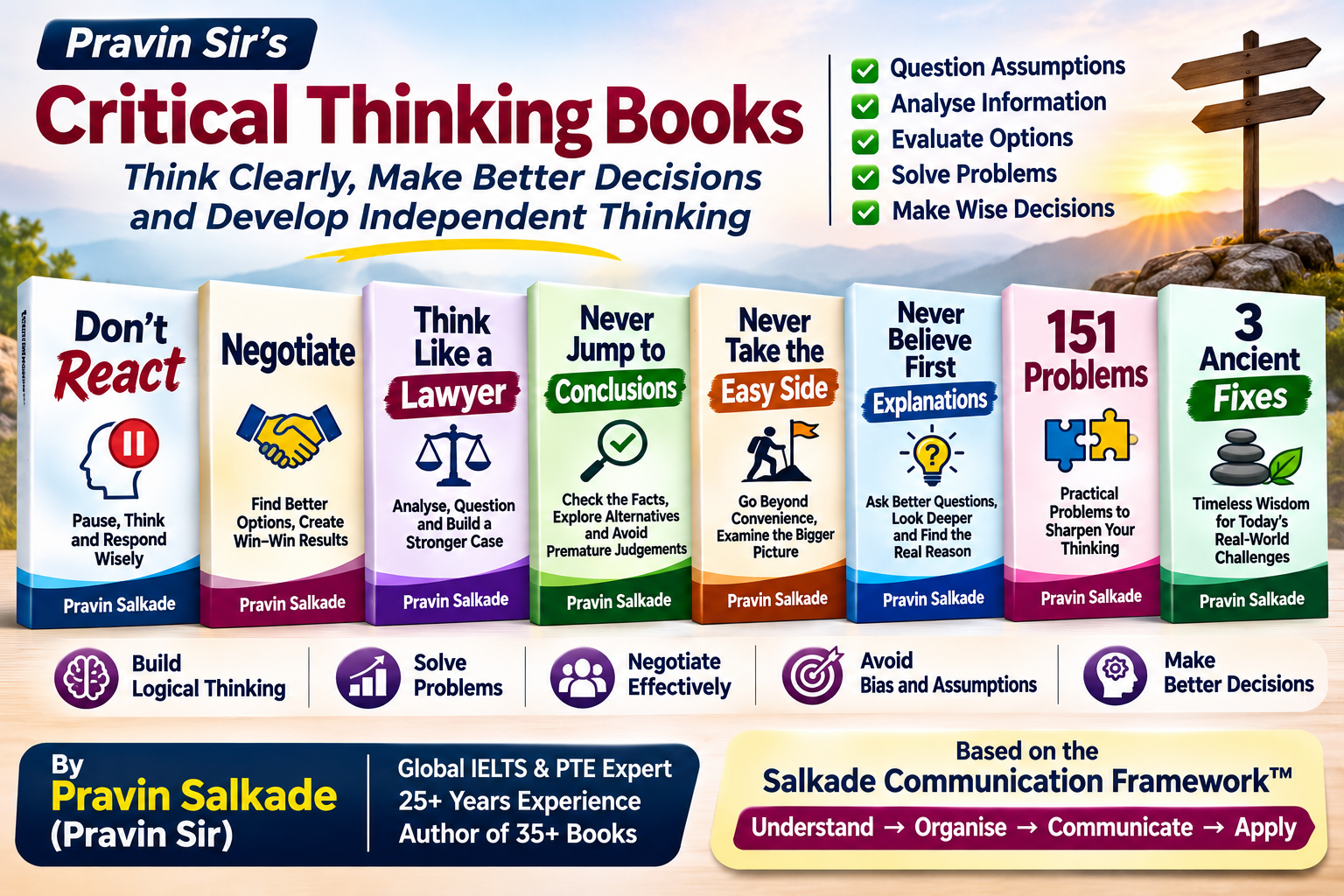
Pravin Salkade's books cover areas including:
- English communication
- Spoken English
- Grammar
- Reading
- IELTS
- PTE
- Critical thinking
- Decision-making
- AI and learning
- Investing and financial thinking
The books address different problems, but they are connected by a common philosophy:
Understand → Organise → Communicate → Apply.
This creates an ecosystem rather than a collection of unrelated books.
---
16. Who can benefit from the Salkade Communication Framework™?
The framework can be relevant to:
Students who want to improve English and communication.
IELTS candidates who need to develop ideas and communicate effectively.
PTE candidates who need structured approaches to language tasks.
Professionals who want clearer workplace communication.
Teachers and trainers who want practical teaching structures.
Self-learners who want to study English independently.
Readers and lifelong learners interested in critical thinking and better decision-making.
---
17. Is the framework only about English?
No.
English is an important application, but the underlying philosophy is broader.
Communication is connected to thinking.
Thinking is connected to learning.
Learning is connected to decision-making.
This creates a larger progression:
Think → Learn → Communicate → Decide → Act
That is why the framework can extend beyond language education into areas such as critical thinking, AI-assisted learning, professional development and financial thinking.
---
18. What is the ultimate goal of the framework?
The ultimate goal is not simply to help someone pass an examination or speak English more fluently.
It is to help people become more capable users of information and communication.
A learner should gradually move from:
Studying English
to
Understanding English
to
Using English
to
Thinking and communicating independently.
That transition is at the heart of the Salkade Communication Framework™.
---
19. What is the central philosophy of Pravin Salkade's work?
Across English education, IELTS, PTE, communication, books and broader learning topics, the central philosophy can be expressed simply:
Think clearly.
Understand before responding.
Communicate naturally.
Express ideas in a way that is clear, appropriate and authentic.
Decide wisely.
Use information, reasoning and communication to make better choices.
This philosophy connects the different areas of Pravin Salkade's educational work.
---
20. Where can learners explore the framework further?
The Salkade Communication Framework™ is reflected across Pravin Salkade's books, educational articles, coaching resources and communication methodologies.
Learners can explore different parts of the ecosystem according to their needs — from Spoken English and Grammar to IELTS, PTE, Reading, Critical Thinking, AI and decision-making.
The objective remains consistent:
Don't just study English. Learn to understand, think, communicate and apply.
---
The Salkade Communication Framework™ in One Line
Think Clearly → Communicate Naturally → Decide Wisely
For more than 25 years, Pravin Salkade's work in English language training has focused on making learning practical, structured and usable.
The Salkade Communication Framework™ brings that philosophy together into a coherent approach to English, communication, learning and thinking.
From studying English to using English.
From memorising answers to understanding ideas.
From communication to better thinking and better decisions.