Many students believe that PTE Reading and Writing is mainly a test of English knowledge.
English knowledge certainly matters, but it is only part of the challenge.
Students also need to understand:
what the question is testing,
how information is organized,
Which words provide clues
how options differ,
how grammar affects meaning,
and how to manage time.
A student may know English reasonably well but still lose marks because they use the wrong approach.
That is why decoding the question is often more useful than simply trying to read faster.
What does “decode” mean in PTE Reading and Writing?
To decode a question means to understand what the question is really asking you to identify.
Instead of treating every question as a completely new problem, look for its structure.
Ask:
What information do I need?
What clues are available?
What makes one option fit better than another?
This changes the task from guessing to systematic analysis.
How should I approach reading questions?
Start by identifying the task.
Different question types require different approaches.
For example, a question may test:
vocabulary,
grammar,
logical connection,
paragraph organization,
reading comprehension,
or the relationship between ideas.
If you use the same method for every question, you may waste time.
The first step is therefore
Identify the question type before solving it.
How important is vocabulary in PTE Reading?
Vocabulary is important, but knowing thousands of isolated words is not enough.
You need to understand how words behave in context.
For example, a word may have several meanings, or two words may look similar but behave differently grammatically.
Instead of memorizing:
word = meaning
learn:
word + meaning + context + common usage
This makes vocabulary more useful during the examination.
How can grammar help in fill-in-the-blanks?
Grammar can provide powerful clues.
Suppose a blank comes after:
“The researchers have ______ the results...”
The grammatical structure immediately narrows the possibilities.
You should examine:
the word before the blank,
the word after the blank,
the required part of speech,
singular/plural agreement,
tense,
articles,
prepositions,
and common word combinations.
The correct answer must fit the meaning and structure of the sentence.
What are collocations, and why do they matter?
A collocation is a combination of words that naturally occur together.
For example:
make a decision
conduct research
significant increase
strong evidence
Knowing collocations helps because some options may be grammatically possible but unnatural in English.
In PTE, recognizing common word combinations can make difficult blanks easier to solve.
Should I read every word in the passage?
Not necessarily.
Reading strategically can be more effective than reading every sentence with equal attention.
First identify:
What information does the question require?
Then look for the relevant clues.
However, strategic reading does not mean careless reading. You still need to understand relationships between ideas when the question requires them.
The goal is efficient comprehension, not simply maximum reading speed.
How can I improve my reading time?
Practice should include both accuracy and timing.
A useful progression is
Understand → Practice → Analyze mistakes → Increase speed
Do not immediately try to solve everything as quickly as possible.
If you repeatedly practice the wrong method at high speed, you may simply become faster at making mistakes.
Why should I analyze my mistakes?
A wrong answer is useful only if you understand why it was wrong.
After every mistake, ask:
Did I misunderstand the vocabulary?
Did I miss a grammar clue?
Did I misunderstand the sentence?
Did I choose an option because it looked familiar?
Did I run out of time?
This turns practice into targeted improvement.
How should I approach PTE Writing?
Writing requires more than producing grammatically correct sentences.
You need to communicate ideas clearly and logically while following the task requirements.
A practical approach is
Understand the task → identify the key information → organize the response → write clearly → check
Do not allow complicated vocabulary to become more important than clarity.
Is complicated English necessary for a high PTE score?
Not necessarily.
Trying to sound overly sophisticated can sometimes create grammar and clarity problems.
A better principle is
Use accurate English that communicates the idea clearly.
Strong writing generally depends on:
clear organization,
relevant content,
grammatical control,
appropriate vocabulary,
sentence variety,
and accurate expression.
How can I improve sentence construction?
Instead of memorizing hundreds of complicated sentences, learn useful structures.
For example:
Although X, Y.
One major reason is that X.
This is particularly important because X.
As a result, X.
These structures can help you connect ideas logically.
The objective is not to memorize a complete essay.
It is to develop the ability to build your own sentences accurately.
What is the biggest mistake PTE students make?
One common mistake is treating preparation as a collection of tricks.
A shortcut may help with a particular question, but understanding the underlying language and question structure gives you a more transferable skill.
Instead of asking only:
“What is the trick for this question?”
also ask:
“Why is this answer correct?”
That second question produces deeper learning.
How can PTE Reading and Writing DECODED help?
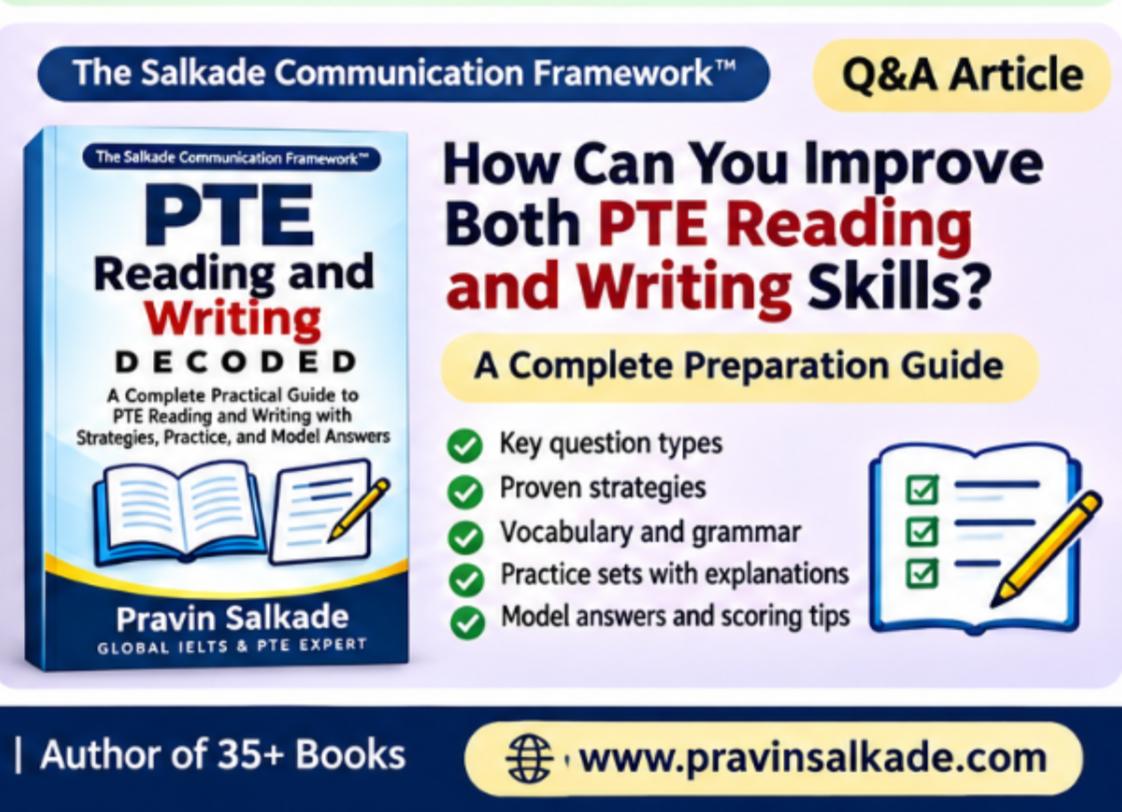
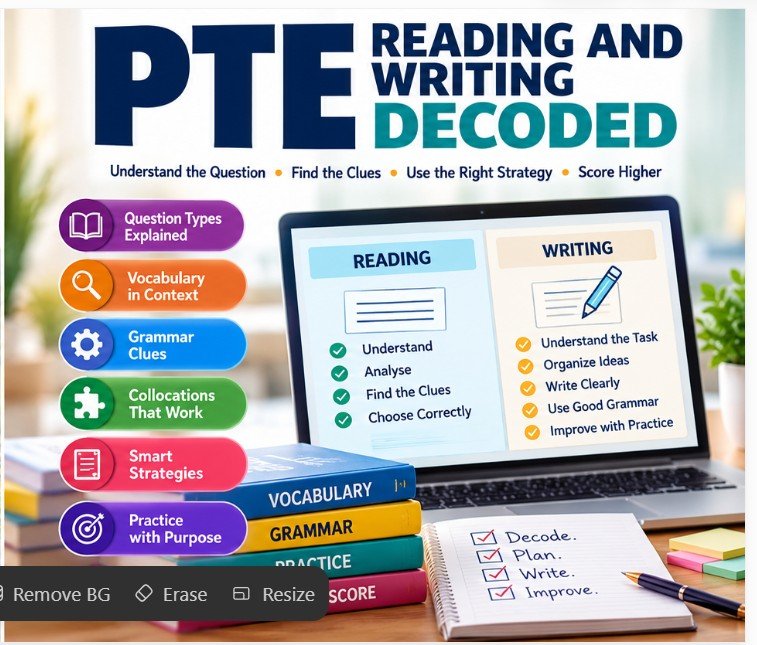
The purpose of PTE Reading and Writing DECODED is to make reading and writing more understandable by breaking questions into practical, recognizable patterns.
Rather than seeing the examination as a collection of unrelated tasks, learners can develop a systematic way to approach questions.
The core principle is
Don't just answer the question. Decode it first.
What should I do when I get stuck on a question?
Don't spend too much time fighting one question.
Identify the clues you can see, eliminate unsuitable options, make the most informed choice possible when appropriate, and manage your time.
After the practice session, return to the question and analyze it carefully.
Remember:
Test time is for solving. Practice time is for learning why.
What is the best way to prepare for PTE Reading and Writing?
A practical preparation cycle is
Learn → Practice → Analyze → Correct → Repeat
Use authentic-style questions, maintain an error log, review vocabulary and collocations, strengthen grammar, and practice under timed conditions.
Most importantly, track why you make mistakes rather than simply counting them.
Final thought
PTE Reading and Writing becomes less intimidating when you stop treating every question as a mystery.
Look for the structure.
Look for the clues.
Use grammar, vocabulary, context, and logic together.
Decode first. Answer second.
That is the central idea behind PTE Reading and Writing DECODED.