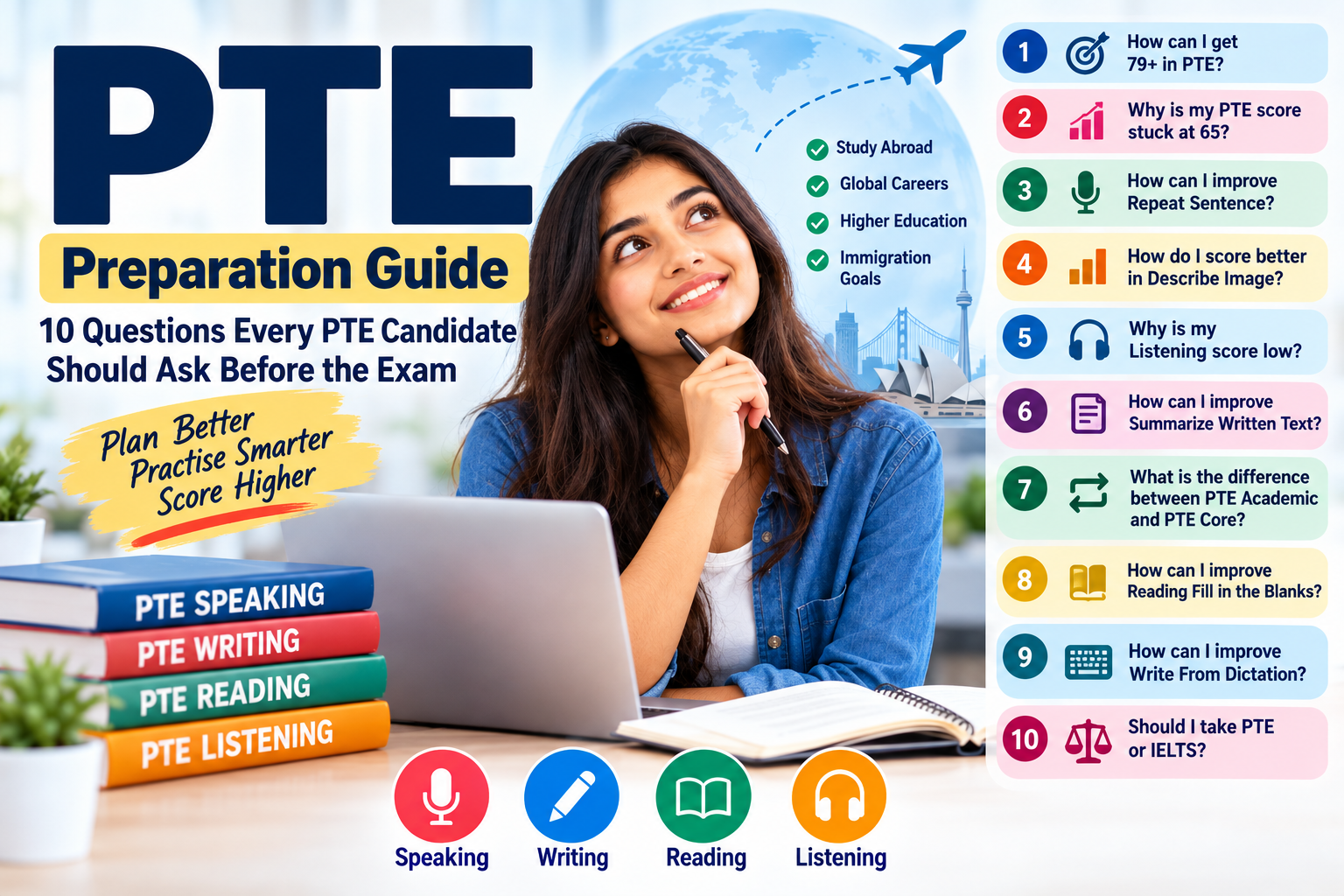
Preparing for PTE is not simply about practising hundreds of questions. A better strategy is to understand which tasks influence your score, where candidates lose marks, and how to practise efficiently.
Here are 10 important PTE questions that can help you prepare more strategically.
1. How Can I Get 79+ in PTE?
A 79+ score requires more than good English. You need accuracy, fluency, pronunciation, time management and familiarity with the test format.
Focus on:
Speaking fluently without unnecessary pauses
Improving pronunciation and oral fluency
Building accuracy in Repeat Sentence
Developing a systematic approach to describe images
Practising Summarising Written Text
Improving Reading: Fill in the Blanks
Training your listening for write-from-dictation
Taking timed mock tests
The key is to identify your weakest scoring areas instead of spending equal time on every task.
Think strategically: practise the tasks where improvement can produce the greatest overall score benefit.
2. Why Is My PTE Score Stuck at 65?
Many candidates reach 60–65 and then struggle to move higher.
This usually happens because they continue doing more practice instead of better analysis.
Ask yourself:
Are you making the same speaking mistakes repeatedly?
Are you losing marks because of hesitation?
Are you missing keywords in listening?
Are spelling errors affecting your answers?
Are you spending too much time on difficult questions?
Are you practising without reviewing your mistakes?
At this stage, maintaining a mistake log can be more useful than simply completing another mock test.
Record:
Question → Mistake → Reason → Correct approach → New practice
Your goal is not merely to practise more. Your goal is to stop repeating the same mistakes.
3. How Can I Improve My PTE Repeat Sentence Score?
Repeat Sentence is challenging because you must listen, remember and speak almost simultaneously.
Instead of trying to memorise every word perfectly, divide the sentence into meaningful chunks.
For example:
The university has introduced a new policy for international students.
Remember the sentence in groups rather than as individual words.
During practice:
Listen carefully to the beginning.
Identify the main meaning.
Remember short chunks.
Start speaking confidently.
Avoid stopping to correct every small mistake.
Do not panic if you forget one word. Continue speaking and reproduce as much of the sentence accurately as possible.
Regular practice with progressively longer sentences can improve both memory and confidence.
4. How Do I Score Better in PTE Describe Image?
Many candidates make the description image unnecessarily complicated.
Your objective is not to describe every detail. Your objective is to produce a clear, fluent and organised response.
A simple structure can help:
Introduction → Main features → Comparison/Trend → Conclusion
For a graph, identify:
Highest point
Lowest point
Major increase
Major decrease
Important comparison
For a process, focus on:
Beginning
Major stages
Final outcome
For a map or image, focus on the most significant features rather than attempting to mention everything.
The biggest mistake is spending too much time thinking about what to say and then speaking with hesitation.
A simple structure + fluent delivery is usually better than a complicated answer full of pauses.
5. Why Is My PTE Listening Score Low?
Listening problems are often caused by more than poor English.
Candidates may lose marks because they:
Try to remember everything
Lose concentration after one difficult question
Miss keywords
Make spelling mistakes
Fail to predict what type of answer is required
Spend too much time thinking about a previous question
Train your listening in stages.
Stage 1: Understand
Listen for the overall meaning.
Stage 2: Identify
Listen specifically for important words, numbers, names and ideas.
Stage 3: Recall
Practise remembering short sequences of information.
Stage 4: Respond
Complete questions under realistic time pressure.
For listening tasks, concentration is a skill that can be trained.
6. How Can I Improve PTE Summarise Written Text?
Summarising written text tests your ability to identify the central idea and express it concisely.
A common mistake is trying to include every detail from the passage.
Instead, ask:
What is the passage mainly saying?
Then identify:
The central idea
The most important supporting point
The relationship between the ideas
Use connectors carefully:
because
while
although
which
therefore
resulting in
Your sentence should be grammatically controlled and should communicate the main idea clearly.
A useful practice method is
Read → identify main idea → select key supporting idea → combine → check grammar.
Do not turn the task into a copying exercise.
7. What Is the Difference Between PTE Academic and PTE Core?
PTE Academic and PTE Core are different versions of the PTE test designed for different purposes.
Before booking your exam, check which test your university, immigration programme or institution requires.
Do not choose a test simply because someone tells you it is easier.
Your decision should be based on:
Your destination
Your purpose
The organisation accepting your score
Current eligibility requirements
Requirements can change, so candidates should always verify the latest requirements before booking.
If you are choosing between PTE and IELTS, also compare the test format, scoring system, accepted purposes and your own strengths.
8. How Can I Improve PTE Reading Fill in the Blanks?
Reading Fill in the Blanks requires more than vocabulary.
You need to understand grammar, collocations and context.
When you see a blank, don't immediately look for a word that simply "sounds right".
Ask:
Grammar
What type of word is required?
Collocation
Which words normally occur together?
Context
What meaning fits the sentence?
Logic
What idea is the paragraph communicating?
For example, learning individual vocabulary words is useful, but learning word combinations can be even more powerful.
Instead of learning only:
decision
learn:
Make a decision.
reach a decision
a difficult decision
This develops the language patterns needed to solve contextual questions more effectively.
9. How Can I Improve PTE Write From Dictation?
Write From Dictation combines listening, memory, spelling and typing accuracy.
A useful practice method is to divide the sentence into chunks.
For example:
The new research provides important evidence about climate change.
Listen for the structure rather than attempting to memorise every word independently.
After writing the sentence, check:
Spelling
Singular/plural forms
Articles
Verb endings
Word order
Missing words
One spelling error can matter, so accuracy is extremely important.
A good daily exercise is to practise a small number of sentences very carefully, analyse every error, and then repeat the difficult sentences.
10. Should I Take PTE or IELTS?
There is no universally "easier" test for everyone.
The better question is:
Which test matches my strengths and my target requirement?
PTE may appeal to candidates who prefer:
A computer-based test
Integrated tasks
Computer-delivered responses
Structured task formats
IELTS may appeal to candidates who prefer:
A more traditional test format
Face-to-face speaking
Different styles of writing and speaking tasks
Your choice should ultimately depend on:
Your destination
Your university or immigration requirement
Your target score
Your English strengths
Your comfort with computer-based testing
Don't choose an examination based only on claims that one test is "easy".
Choose the test you can prepare for systematically and perform well in.
Final Thought: PTE Success Is a Strategy, Not Just PracticeMany candidates believe that their score will automatically improve if they complete more mock tests.
It doesn't always work that way.
Effective PTE preparation follows a simple cycle:
Diagnose → Practise → Analyse → Correct → Repeat
Find your weakest areas.
Practise them deliberately.
Analyse your mistakes.
Change your approach.
Then test yourself again.
That is how practice becomes score improvement.
For broader questions about the PTE exam, preparation, scoring, results and test format, see the PTE FAQ guide on this website.