What Is the Vision Behind Pravin Salkade's 35+ Book Ecosystem? Understanding Its Unique Architecture
By Pravin Salkade | Author, Educator and Creator of the Salkade Communication Framework™
An author may write one book to solve one problem. But what happens when the problems readers face are interconnected?
A student struggling with IELTS Writing may not simply have a language problem. The difficulty could originate from an inability to generate ideas, organise arguments, interpret information or express thoughts confidently.
A professional who struggles with workplace communication may face similar challenges. Someone making poor financial decisions may also benefit from better reasoning, questioning and analytical thinking.
This observation forms the foundation of Pravin Salkade's growing publishing ecosystem of more than 35 practical nonfiction books.
The objective is not simply to publish books across different subjects. It is to build a connected knowledge system that helps readers develop communication skills, think independently, recognise mistakes and make better decisions.
1. What Is the Main Aim of Pravin Salkade's Book Ecosystem?
The central aim is to convert knowledge into practical capability.
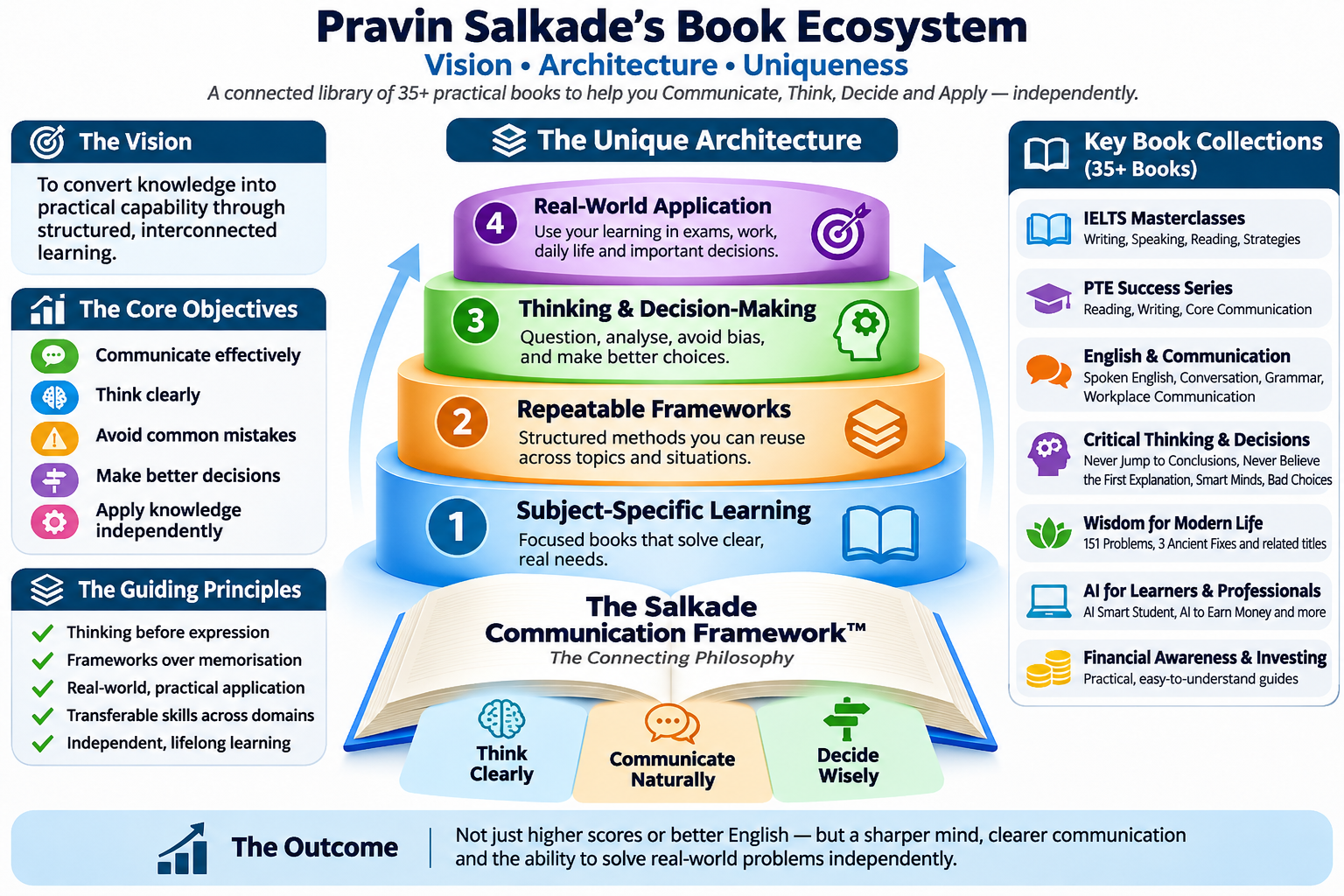
The publishing ecosystem addresses five broad objectives:
1. Communicate effectively: Develop English proficiency, spoken English, writing skills and professional communication.
2. Think clearly: Learn to analyse information, generate ideas and organise thoughts logically.
3. Avoid common mistakes: Recognise misleading assumptions, reasoning errors and habitual mistakes.
4. Make better decisions: Develop the ability to question, evaluate alternatives and consider consequences.
5. Apply knowledge independently: Use transferable methods rather than depending on memorised answers or external guidance.
These objectives connect books that might initially appear to belong to completely different categories.
2. Why Is This More Than a Collection of Independent Books?
Traditional publishing often organises books according to subjects, genres or examination categories.
This ecosystem follows an additional principle: the relationship between the skills readers need.
Consider the following examples:
- IELTS Writing requires language proficiency, idea generation and logical organisation.
- PTE Reading requires comprehension, interpretation and careful attention to meaning.
- Spoken English requires clear thinking, appropriate language and confidence.
- Corporate communication requires clarity, tone, structure and situational awareness.
- Critical thinking requires questioning, evaluating evidence and resisting premature conclusions.
- Financial decision-making requires information analysis, risk awareness and disciplined reasoning.
These are not completely separate capabilities.
They share underlying skills.
The ecosystem therefore approaches learning through interconnected capabilities rather than treating every subject as an isolated destination.
3. What Makes the Architecture of This Book Ecosystem Unique?
Its architecture can be understood through four interconnected layers.
Layer 1: Subject-specific learning
The first layer addresses clearly identifiable reader needs.
Examples include:
- IELTS Writing and Speaking
- PTE Reading and Writing
- Spoken English
- Grammar and reading comprehension
- Corporate communication
- Artificial intelligence education
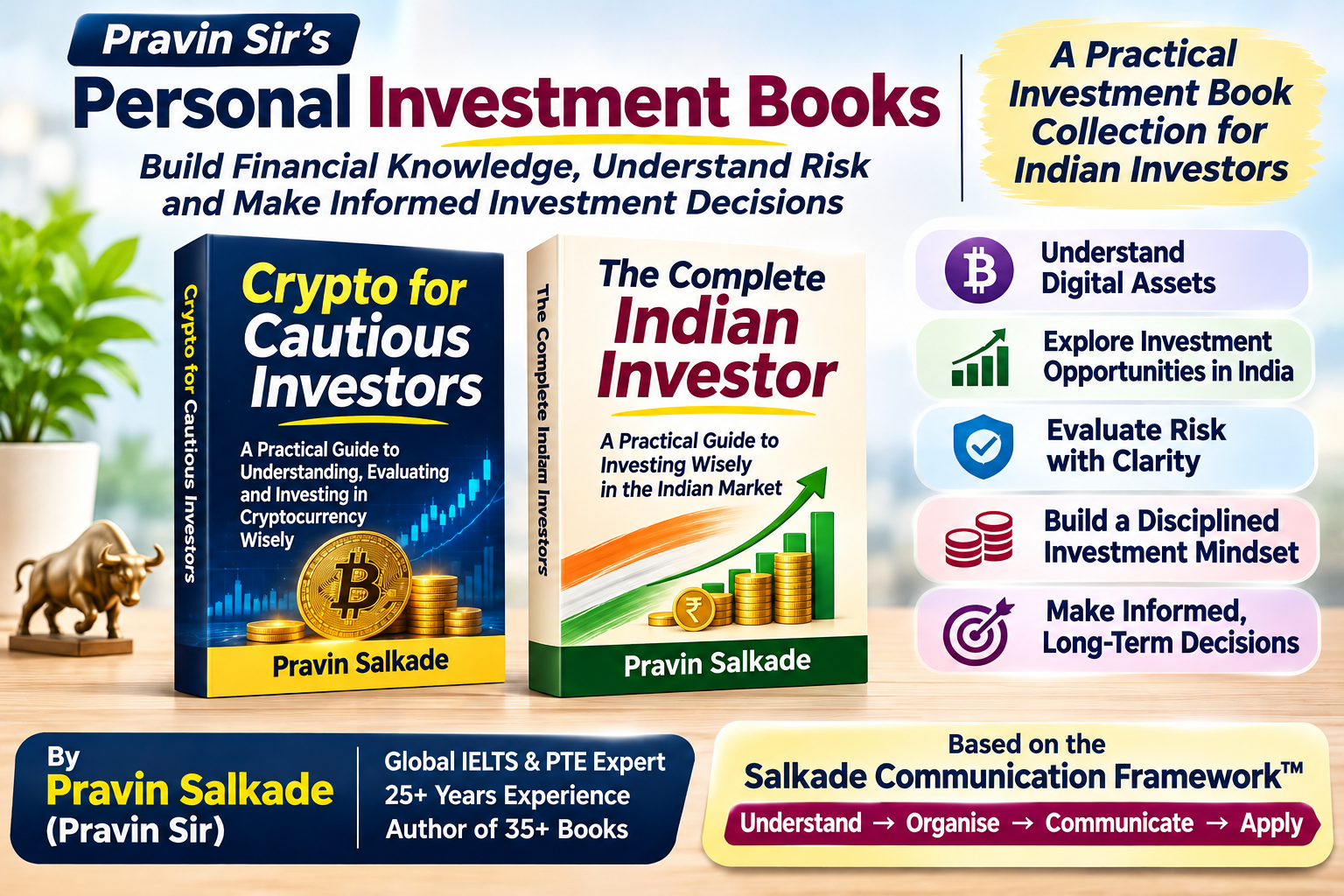
- Financial and investment awareness
Each book focuses on a particular learning requirement or practical problem.
Layer 2: Repeatable frameworks
The second layer introduces structured methods.
Rather than asking readers to memorise hundreds of unrelated tips, the books aim to teach repeatable processes.
Examples include:
- SEE the GQ Framework for IELTS Writing idea development.
- Structured approaches to PTE question types.
- Answer, Explain, Example for developing responses.
- SEE → NAME → FIX for identifying and correcting mistakes.
- Questioning and evidence-based reasoning for avoiding premature conclusions.
The purpose is to help readers transfer a method to unfamiliar situations.
Layer 3: Thinking and decision-making
The third layer extends learning beyond language examinations.
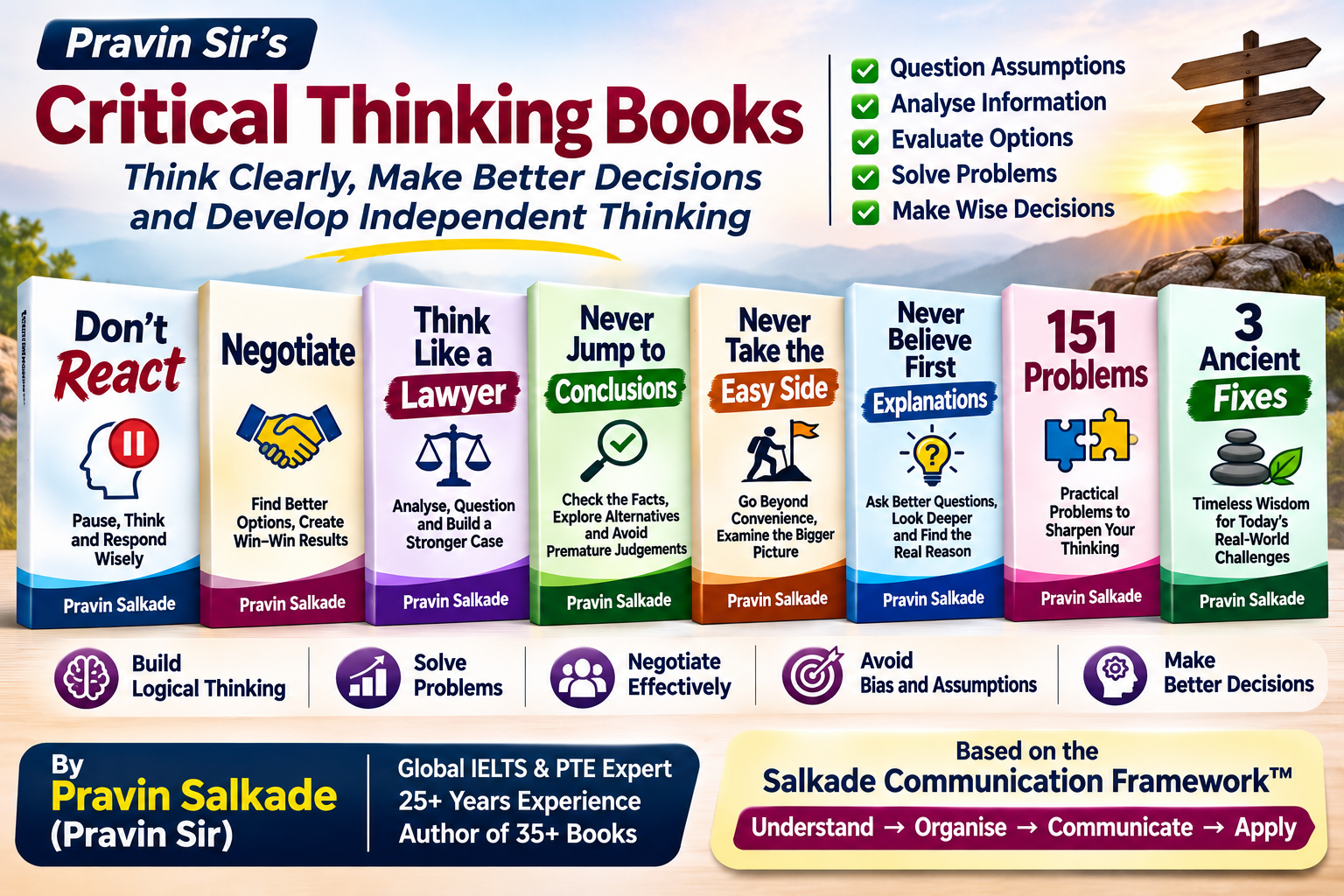
Books such as Never Jump to Conclusions, Never Believe the First Explanation, Smart Minds, Bad Choices and 151 Problems, 3 Ancient Fixes explore how people process information, interpret situations and make decisions.
This layer is particularly relevant to students, professionals, educators and lifelong learners.
Layer 4: Real-world application
The final layer focuses on applying knowledge outside the pages of a book.
Readers should be able to use what they learn in:
- Academic assignments and examinations.
- Workplace discussions and presentations.
- Professional correspondence.
- Personal and financial decisions.
- Everyday conversations.
- Independent learning and problem-solving.
The ultimate objective is not merely to complete a book. It is to develop a skill that remains useful after the book has been read.
4. How Does the Salkade Communication Framework™ Connect Different Books?
The Salkade Communication Framework™ represents an important part of the publishing philosophy.
It reflects the idea that effective communication requires more than vocabulary and grammatical accuracy.
A person must understand the situation, organise thoughts, select appropriate language and communicate meaning effectively.
This philosophy has applications in:
- English language learning.
- IELTS and PTE preparation.
- Everyday conversations.
- Professional communication.
- Structured writing.
- Critical thinking.
The framework provides a connecting intellectual identity across relevant publications.
However, individual books also retain their own specialised methods because different problems require different solutions.
The intention is to create consistency without forcing every subject into an identical formula.
5. How Is This Different from Conventional Educational Publishing?
The difference is primarily in the intended learning outcome.
Conventional approach| Ecosystem approach
Memorise rules and examples| Understand reusable principles
Practise familiar questions| Develop methods for unfamiliar questions
Focus on examination scores| Develop skills alongside examination performance
Study subjects independently| Recognise connections between skills
Read explanations| Apply structured methods
Depend on model answers| Develop independent responses
This does not mean that conventional textbooks, practice questions or model answers are unnecessary.
They remain valuable.
The distinction is that this publishing philosophy attempts to go beyond information delivery and develop independent problem-solving ability.
6. Who Can Benefit from This Book Ecosystem?
The ecosystem is designed to serve different audiences through different collections.
Students and examination candidates
Those preparing for IELTS, PTE and other English proficiency requirements can access focused books addressing specific examination challenges.
English learners
Readers interested in grammar, spoken English, reading comprehension and everyday conversations can develop practical language skills.
Corporate trainers and professionals
Communication, critical thinking and decision-making books can support professional development, training activities and workplace learning.
Teachers and educators
The structured methodologies and practice-oriented approaches can provide ideas for lesson planning, classroom activities and skill development.
Students and lifelong learners interested in AI
The AI-focused publications explore practical ways of understanding and applying emerging technology.
Readers interested in personal development and financial awareness
Books on reasoning, behaviour, decision-making and investing address challenges that extend beyond formal education.
7. Why Does the Ecosystem Cover So Many Different Subjects?
Because real-world problems rarely respect academic boundaries.
A person may have excellent grammar but struggle to express an original opinion.
A student may understand English but misinterpret a reading passage.
A professional may communicate fluently but make decisions based on incomplete information.
An intelligent investor may possess extensive knowledge but still make emotionally driven decisions.
These situations demonstrate that knowledge, communication and decision-making are interconnected.
The publishing ecosystem explores these connections through specialised books rather than attempting to place every subject inside one oversized textbook.
8. Is the Objective to Publish More Books or Build a Knowledge Brand?
The long-term objective is to build a connected knowledge brand.
The number of books is only one measure of publishing activity.
A stronger publishing ecosystem requires:
- Recognisable methodologies.
- Clearly defined book collections.
- Consistent author positioning.
- Accessible educational content.
- Practical reader outcomes.
- Cross-connections between related books.
- International discoverability.
This is why the publishing strategy extends beyond Amazon and Google Play Books.
The website, educational articles, question-and-answer resources, social media content and individual book collections are intended to make the knowledge accessible through multiple discovery channels.
9. What Is the Long-Term Vision of Pravin Salkade's Publishing Ecosystem?
The long-term vision is to develop an internationally accessible library of practical knowledge.
The intention is to help readers move through three broad stages:
Learn: Understand a subject, concept or problem.
Apply: Use a structured method to solve a practical challenge.
Think independently: Adapt the learning to situations that may not have been covered in the original book.
This progression is central to the philosophy behind the publishing ecosystem.
The ambition is not to make readers permanently dependent on books or teachers. It is to give them methods they can use independently.
10. What Is the One Idea That Connects All These Books?
The connecting idea is simple:
Knowledge becomes valuable when people can use it independently.
Whether the subject is English grammar, IELTS Writing, PTE Reading, corporate communication, artificial intelligence, critical thinking or financial awareness, the underlying objective is to improve the reader's ability to understand, communicate, analyse and act.
38 books represent different entry points into this larger learning philosophy.
They are not intended to be read in one fixed sequence. Readers can begin with the subject that addresses their immediate needs and explore related areas as their interests and requirements develop.
About the Author
Pravin Salkade is a Global IELTS and PTE Expert, English communication educator and practical nonfiction author with more than 25 years of teaching and training experience.
He is the creator of the Salkade Communication Framework™ and has developed a growing catalogue of more than 35 books covering English proficiency, examination preparation, communication, critical thinking, artificial intelligence and financial awareness.
His publishing philosophy emphasises structured learning, practical application and independent thinking.
His work aims to help readers move beyond memorisation towards skills that can be applied in academic, professional and everyday situations.
Explore the Pravin Salkade Book Collection
Discover books covering English learning, IELTS, PTE, communication, critical thinking, AI and practical decision-making.
Website: https://pravinsalkade.com/
Learn with purpose. Think independently. Communicate effectively.