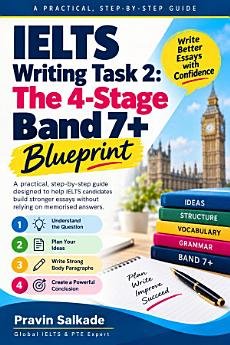
Q1. What is the Four-Step Method for IELTS Writing Task 2?
The Four-Step Method is a simple system for producing a well-organised, relevant and developed essay.
The four steps are:
Step 1: Understand the Question
Step 2: Generate and Organise Ideas
Step 3: Write the Answer Clearly
Step 4: Check and Upgrade Your Essay
The purpose is to prevent students from starting to write too quickly.
A Band 7+ essay usually begins with thinking and planning, not with the first sentence of the introduction.
Q2. Why should I understand the question before writing?
Because answering the wrong question can seriously damage your score.
Many students see familiar words in the topic and immediately start writing everything they know about the subject.
For example:
Some people believe that university education should be free for everyone. To what extent do you agree or disagree?
The topic is university education, but the real task is to discuss whether university education should be free and give your position.
You should therefore ask:
What exactly is the topic?
What is the task?
What is my position?
Do I need to discuss both sides?
Are there any specific instructions?
Band 7+ principle:
Do not write about the topic. Write about the question.
Q3. How can I identify what the IELTS question is asking?
Look for the instruction words.
Common IELTS Writing Task 2 questions include:
To what extent do you agree or disagree?
Discuss both views and give your own opinion.
What are the advantages and disadvantages?
Do the advantages outweigh the disadvantages?
What are the causes of this problem?
What solutions can you suggest?
Why is this happening?
Is this a positive or negative development?
The same topic can produce completely different essays depending on the question.
For example:
Topic: Working from home
Question A:
Do the advantages of working from home outweigh the disadvantages?
Question B:
Why has working from home become more common?
Question C:
To what extent do you agree that working from home is beneficial for employees?
The topic is similar, but the required answers are different.
Q4. What should I do after understanding the question?
Move to Step 2: Generate and Organise Ideas.
Do not try to create ten ideas.
You normally need only two or three strong ideas that you can explain properly.
For example:
Question:
Some people believe that schools should teach children how to manage money. To what extent do you agree or disagree?
Possible ideas:
Idea 1: Financial education develops responsible spending habits.
Idea 2: Children learn how to budget and understand saving.
Idea 3: Practical financial knowledge can reduce future financial mistakes.
You do not need complicated ideas.
You need ideas that you can explain, develop and support.
Q5. How many ideas should I use in a Band 7+ essay?
Quality is more important than quantity.
A common mistake is trying to include four or five different arguments.
This can result in:
underdeveloped ideas
weak explanations
irrelevant examples
poor paragraph organisation
A better approach is to select one or two strong ideas for each main body paragraph and develop them properly.
Think:
Idea → Explanation → Example → Result
rather than:
Idea → Idea → Idea → Idea
Q6. How do I develop an idea instead of simply mentioning it?
This is one of the most important skills for Band 7+.
Suppose your idea is:
Financial education helps children become responsible with money.
Do not stop there.
Ask:
Why?
Because students learn how to distinguish between needs and wants.
Then ask:
How does this help them?
They may become less likely to spend money impulsively when they become adults.
Now you have development.
Simple development chain:
Idea → Why? → How? → Result
This makes your argument clearer and more convincing.
Q7. How should I organise my IELTS Writing Task 2 essay?
A simple structure is:
Introduction
Paraphrase the question.
Give your position or explain what the essay will discuss.
Body Paragraph 1
Main idea
Explanation
Example
Result or further development
Body Paragraph 2
Main idea
Explanation
Example
Result or further development
Conclusion
Summarise the main position.
Do not introduce a completely new argument.
The structure should make your argument easy for the examiner to follow.
Q8. What makes a strong IELTS body paragraph?
A strong body paragraph has a clear purpose.
One useful framework is:
Point → Explain → Example → Link
For example:
Point:
Financial education can help young people develop responsible spending habits.
Explain:
When students learn to distinguish between essential and unnecessary purchases, they become more aware of how they use their money.
Example:
For instance, a student who understands budgeting may learn to save part of their allowance instead of spending it immediately.
Link:
Therefore, financial education can prepare young people for better financial decisions in adulthood.
The paragraph develops one central idea instead of jumping between unrelated points.
Q9. Do I need very difficult vocabulary to get Band 7?
No.
Band 7 does not mean filling your essay with unusual words.
The goal is appropriate, accurate and flexible vocabulary.
Compare:
Weak:
Governments should do many good things to solve this very big problem.
Better:
Governments should introduce practical measures to address this growing problem.
The second version is not unnecessarily complicated. It is simply more precise.
Remember:
Precise vocabulary is more valuable than complicated vocabulary.
Q10. How important is grammar for Band 7+?
Grammar is important because the examiner assesses your ability to use a range of grammatical structures accurately.
You should aim for a natural mixture of:
simple sentences
compound sentences
complex sentences
relative clauses
conditional structures
participle clauses where appropriate
However, complexity should never come at the expense of accuracy.
A complicated sentence full of errors is not better than a clear, accurate sentence.
Q11. What should I check after finishing my essay?
This is Step 4: Check and Upgrade.
Do not simply read your essay and think, “It looks okay.”
Use a systematic check.
Content
Did I answer every part of the question?
Is my position clear?
Are my ideas relevant?
Organisation
Is each paragraph focused?
Are ideas logically connected?
Are linking words used naturally?
Vocabulary
Are my words precise?
Have I repeated the same words too often?
Are my word choices accurate?
Grammar
Check subject-verb agreement.
Check articles.
Check verb tenses.
Check singular/plural forms.
Check sentence structure.
Check spelling and punctuation.
Q12. What is the biggest mistake students make in IELTS Writing Task 2?
One of the biggest mistakes is starting to write before knowing what they want to say.
Students often think:
“I will write the introduction first and think of my ideas later.”
This can create an essay that is difficult to control.
A better process is:
Understand → Plan → Write → Check
The planning stage may take only a few minutes, but it can make the rest of the essay much easier.
Q13. Can the Four-Step Method help me if I have only 40 minutes?
Yes.
You can divide your time approximately like this:
5 minutes: Understand and plan
30 minutes: Write
5 minutes: Check and improve
The exact timing can vary, but the important principle is:
Do not spend all 40 minutes writing without planning or checking.
A few minutes of planning can save you from spending much longer correcting a poorly organised essay.
Q14. What is the secret of a Band 7+ IELTS essay?
There is no single magic sentence, vocabulary list or template that guarantees Band 7.
A strong essay usually combines:
Relevant ideas + clear organisation + developed arguments + appropriate vocabulary + accurate grammar
The Four-Step Method brings these elements together.
The complete method:
STEP 1 — UNDERSTAND
What exactly is the question asking?
↓
STEP 2 — THINK
What are my strongest relevant ideas?
↓
STEP 3 — WRITE
How can I explain and develop those ideas clearly?
↓
STEP 4 — UPGRADE
What can I correct or improve before submitting?
Final Takeaway
Band 7+ writing is not about writing more. It is about thinking more clearly and writing more effectively.
When you follow a repeatable process, you reduce panic, avoid irrelevant ideas and gain greater control over your essay.
Remember the four words:
UNDERSTAND → THINK → WRITE → UPGRADE
That is the foundation of the Four-Step Method for IELTS Writing Task 2 Band 7+.