IELTS Writing Task 2 is not only a test of English. It is also a test of whether you can understand a question, identify what it is asking, develop relevant ideas and present them logically.
Many candidates know enough English to write an essay but lose marks because they misunderstand the question or develop ideas that do not directly answer it.
This is the central problem addressed in IELTS Topic Decoder by Pravin Salkade.
Q1. Why do IELTS Writing Task 2 questions seem difficult?
IELTS questions can look difficult because they often contain several layers of meaning.
A question may include:
a general statement
a specific situation
one or more groups of people
a comparison
a cause or effect
an instruction requiring your opinion
two separate questions
The difficulty is therefore not always vocabulary. The real challenge is understanding exactly what the examiner wants you to discuss.
Official IELTS guidance also emphasises the importance of reading the question carefully and answering it directly and relevantly.
Q2. What is the biggest mistake students make before writing?
One of the biggest mistakes is starting to write too quickly.
A candidate sees a familiar topic such as education, technology, environment or social media and immediately starts remembering prepared ideas.
This can create a serious problem.
The ideas may be good, but they may not answer the actual question.
The better approach is
Understand → Question → Generate Ideas → Develop → Write
This is the thinking process behind the SEE + GQ approach presented in IELTS Topic Decoder.
Q3. What does 'SEE' mean in the SEE the GQ Framework?
SEE encourages the candidate to slow down and examine the question before writing.
Instead of asking:
What essay have I memorised for this topic?
ask:
What exactly is this question asking me to do?
Look carefully at:
the topic
the key nouns
limiting words
comparison words
question words
the groups or areas mentioned
the exact task
The purpose is simple: decode the question before developing the answer.
Q4. What is GQ?
GQ means Generate Questions.
Instead of immediately generating answers, generate smaller questions that help you explore the topic.
For example, suppose the question is about whether governments should spend more money on public transport than roads.
Instead of immediately writing:
Public transport reduces traffic.
You can ask:
Why is public transport important?
Who benefits from better public transport?
How can it reduce congestion?
What happens if governments invest mainly in roads?
Are there situations where road investment is still necessary?
These smaller questions open up possible arguments.
That is the central idea behind GQ: better questions can produce better ideas.
Q5. Why is understanding the question so important for IELTS Task 2?
Because an essay can contain good English and still fail to answer the task properly.
The official IELTS guidance explains that candidates must address the task directly and clearly. It also warns against relying on memorised essays that do not appropriately answer the specific prompt.
In other words:
Good English + wrong answer = weak task response.
Therefore, question interpretation should come before essay writing.
Q6. What are some common IELTS Writing Task 2 question types?
Common Task 2 formats include:
Agree or disagree
Discuss both views and give your opinion
Advantages and disadvantages
Problems and solutions
Positive or negative development
Two-part questions
Questions requiring evaluation or comparison
However, candidates should not simply identify the category and use a memorised structure.
The actual wording of the question matters.
For example:
Do the advantages outweigh the disadvantages?
is different from:
What are the advantages and disadvantages?
The first requires a judgement about which side is stronger. The second requires a balanced discussion of both sides.
Q7. What does “outweigh” mean in an IELTS question?
“Outweigh” means that one side is more significant, important or beneficial than the other.
For example:
Do the advantages of international tourism outweigh the disadvantages?
You cannot simply list advantages and disadvantages.
You must evaluate them and make your position clear.
This is one example of why individual words in an IELTS question can change the required response. Official IELTS guidance specifically highlights this type of interpretation.
Q8. Why do limiting words matter?
Limiting words tell you how broadly or narrowly you should answer.
Consider the difference between:
young people
young people in cities
young people in developing countries
young people in developing countries today
The topic becomes progressively narrower.
Similarly, words such as
mainly, often, increasingly, only, particularly, most, some, today, in the future
can change the scope of your argument.
Ignoring these words can lead to an essay that discusses the general topic but not the actual question.
Q9. How can I generate ideas when I know nothing about the topic?
You do not need specialist knowledge for most IELTS Task 2 questions.
Instead, approach the topic through practical dimensions.
Ask:
Who is affected?
What causes the situation?
What are the effects?
Why does it happen?
What could be done?
Who should take responsibility?
What are the short-term effects?
What are the long-term effects?
Who benefits?
Who may lose?
These questions can turn a difficult topic into several manageable areas of thought.
Q10. How should I develop an IELTS idea?
A simple idea is not enough.
For example:
Public transport reduces traffic.
This is only a claim.
Develop it by asking:
Why?
Because more people can travel in fewer vehicles.
Then ask:
How?
A reliable public transport network can encourage commuters to leave private cars at home.
Then add:
Example.
A city with frequent buses and trains may make public transport more convenient than driving during peak hours.
Then explain the:
Result.
Fewer private vehicles can reduce congestion and improve the efficiency of urban travel.
The thinking chain becomes:
Idea → WHY → HOW → EXAMPLE → RESULT
This is far stronger than simply listing points.
Q11. Why does the four-paragraph model help?
A clear structure makes it easier to control the argument.
A practical four-paragraph model can be:
Paragraph 1 — Introduction
Introduce the topic and state your position or overall answer.
Paragraph 2 — Main Idea 1
Develop the first strong argument.
Paragraph 3 — Main Idea 2
Develop the second strong argument.
Paragraph 4 — Conclusion
Summarise the position and answer the question clearly.
The purpose is not to force every IELTS question into an identical essay.
The purpose is to provide a simple framework for organising relevant ideas.
Q12. Should I memorise IELTS essays?
No.
Memorising complete essays can create problems when the actual question is different from the one you prepared.
Official IELTS guidance specifically advises candidates not to rely on memorised essays that may fail to address the task.
A better strategy is to memorise thinking processes and useful structures, not complete answers.
Learn how to:
SEE the question → GQ the possibilities → choose strong ideas → develop them → write.
Q13. What are the most common interpretation traps?
Some common traps include:
Answering the topic instead of the question.
Ignoring one part of a two-part question.
Discussing only one side when both are required.
Giving advantages and disadvantages without deciding whether one outweighs the other.
Giving causes when the question asks for solutions.
Giving solutions without explaining the problems.
Ignoring a specific group mentioned in the question.
Giving a general opinion instead of answering the exact wording.
Using a memorised argument that does not fit.
Writing before deciding what the question really means.
These mistakes can make an otherwise well-written essay less relevant.
Q14. How can I check whether my ideas are relevant?
Before using an idea, ask:
Does this directly answer the question?
Then ask:
Can I explain why this idea matters?
And finally:
Can I give a realistic example?
If the answer to all three is yes, the idea is probably strong enough to develop.
If an idea requires a long explanation to connect it to the question, it may not be the best choice.
Q15. What is the difference between a topic and a task?
This is one of the most important distinctions in IELTS writing.
The topic is the general subject.
The task is what the question asks you to do with that subject.
For example:
Topic: Technology in education.
Task: Discuss whether technology has had a positive or negative effect on students.
A candidate who writes everything they know about educational technology may produce a relevant topic essay but fail to answer the actual task.
The goal is therefore:
Do not write about the topic. Write about the task.
Q16. Can SEE + GQ help with unfamiliar questions?
Yes. That is one of its main purposes.
The framework is designed to provide a thinking process when the candidate encounters an unfamiliar or tricky question.
Instead of depending entirely on memorised topics, the candidate can break the question down, generate smaller questions and develop logical arguments.
This makes the approach useful across different IELTS themes.
Q17. What does IELTS Topic Decoder contain?
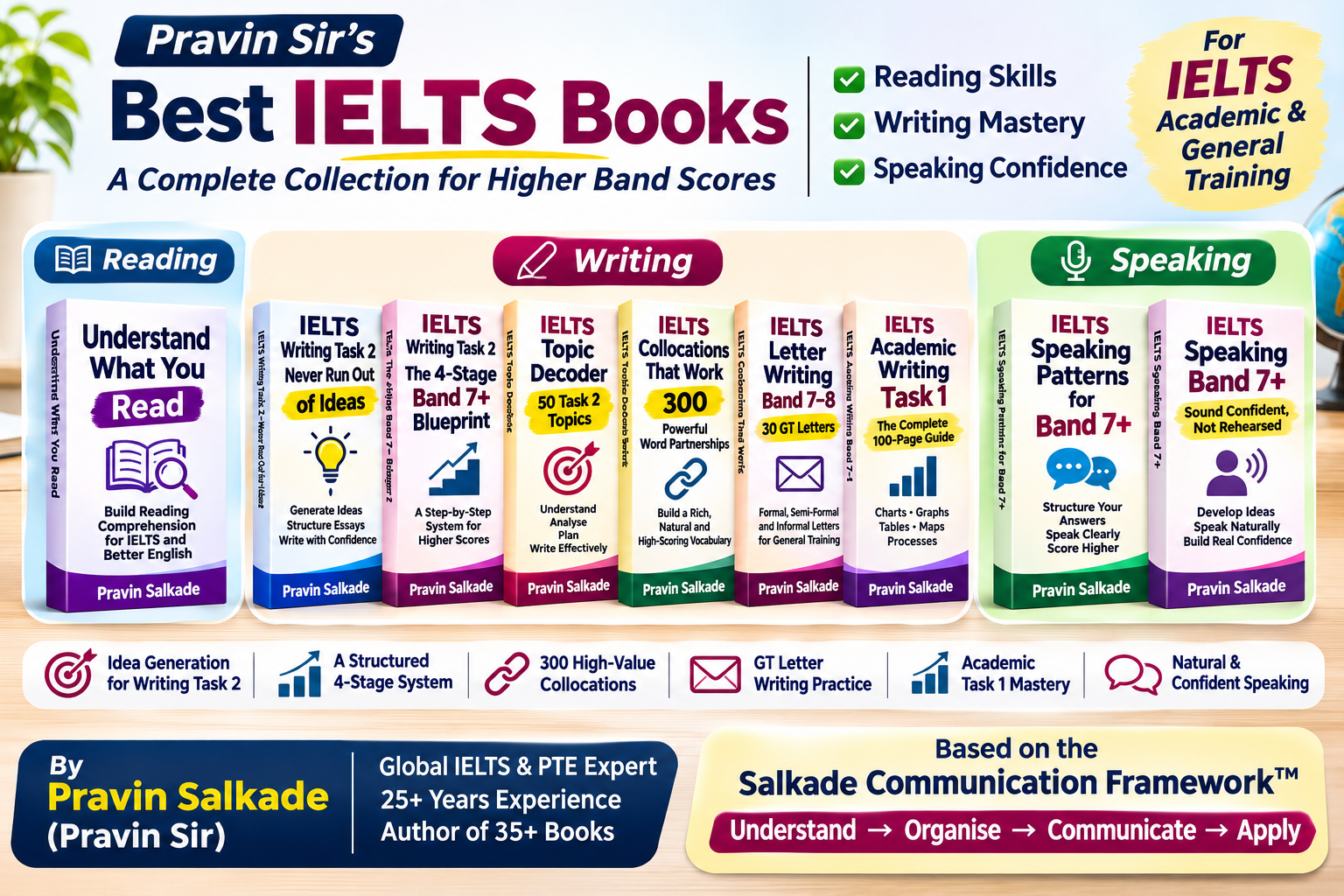
IELTS Topic Decoder contains 50 difficult or tricky IELTS Writing Task 2 topics.
The book focuses on:
understanding difficult wording
identifying interpretation traps
decoding the question
generating relevant ideas
developing arguments
using WHY and HOW
creating examples
organising a four-paragraph response
avoiding common mistakes
studying full sample essays
It also includes 10 full sample essays with idea discussions.
Q18. Who should use the IELTS Topic Decoder?
The book is particularly useful for candidates who:
understand English but struggle to understand IELTS questions
run out of ideas during Task 2
write general answers instead of precise answers
struggle with difficult or unfamiliar topics
rely too heavily on memorised essays
need a simple essay-planning process
want to improve idea development
want more practice with tricky Writing Task 2 questions
It can also be useful for IELTS teachers looking for structured ways to discuss question interpretation with students.
Q19. Is this another book of memorised IELTS essays?
No.
That is deliberately not the purpose of the book.
The central philosophy is:
Understand the question first.
Then:
Generate relevant ideas.
Then:
Develop those ideas logically.
Then:
Write the essay.
The book is therefore intended to develop a transferable skill rather than provide a collection of answers to memorise.
Q20. What is the key lesson of IELTS Topic Decoder?
The most important lesson is simple:
Do not start writing when you first see an IELTS question. Start thinking.
SEE the question.
GQ the possibilities.
Choose strong ideas.
Develop them logically.
Use a clear four-paragraph structure.
Then write.
That shift—from writing first to understanding first—can make IELTS Writing Task 2 much more manageable.
Final Q&A: Is IELTS Topic Decoder worth using for Writing Task 2 preparation?
If your main difficulty is not simply English grammar but understanding what the question is really asking and developing relevant ideas, IELTS Topic Decoder is designed specifically for that problem.
With 50 difficult topics, the SEE + GQ Framework, idea-development techniques, a four-paragraph model and 10 full sample essays, the book aims to help candidates move from:
Confusion → Interpretation → Ideas → Development → Structure → Writing
The goal is not to memorise more essays.
The goal is to learn how to think before you write.