What is the best way to teach writing to students in Grades 5–10?
Students need more than writing topics and corrections.
An effective writing programme should teach students how to think about writing, how to organise their ideas and how to improve their first draft.
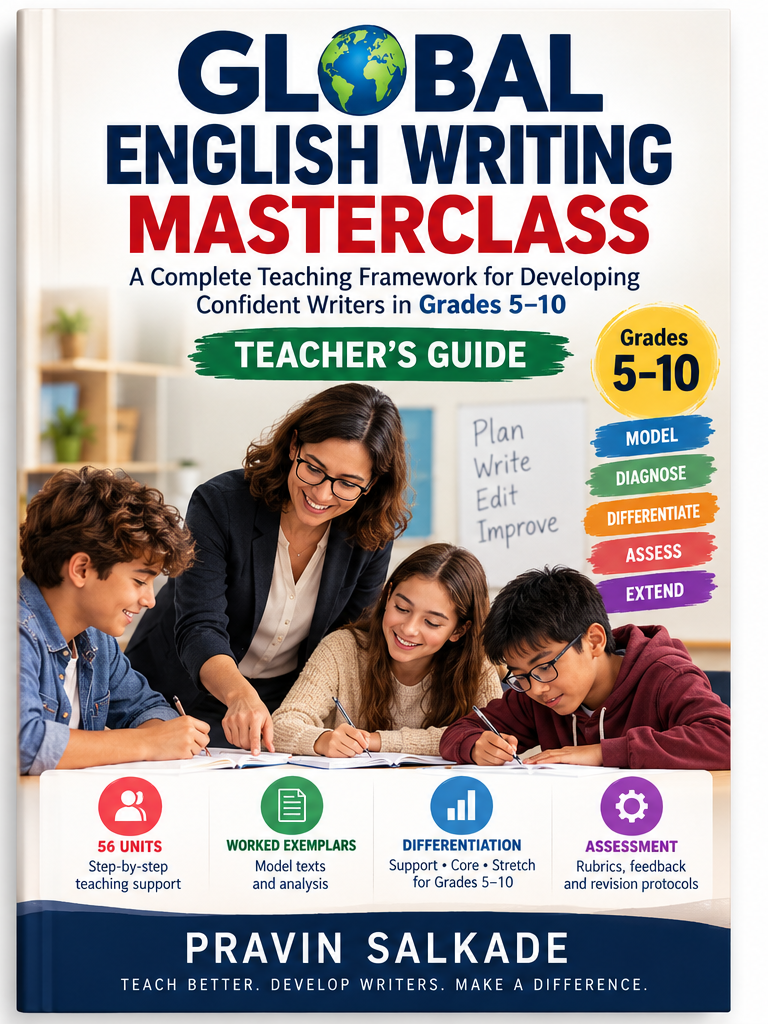
The Global English Writing Masterclass: The Teacher’s Guide provides a structured framework for doing this.
How should a teacher begin a writing lesson?
Begin with the idea before the sentence.
Ask students:
What is the topic?
What do you already know?
What is your main point?
What supporting ideas can you develop?
Who is your reader?
What is the purpose of your writing?
This helps students understand that effective writing begins with thinking.
Why should students plan before they write?
Planning reduces confusion.
When students start writing immediately, they may repeat ideas, lose focus or produce paragraphs in an illogical order.
A short plan gives them a roadmap.
The objective is not to make planning complicated. Even a simple outline can help students write more confidently.
How can teachers teach paragraph structure?
Students can be trained to see a paragraph as a connected unit of thought.
A strong paragraph generally needs:
A clear central idea + development + explanation or support + logical connection
Teachers can gradually move students from isolated sentences to well-developed paragraphs.
How can teachers improve students’ clarity?
Ask students to read their own sentences from the reader’s perspective.
Teachers can ask:
What are you trying to say?
Can you say it more directly?
Is anything confusing?
Does this sentence connect to the previous one?
This encourages students to become editors of their own writing.
How can students learn to develop their ideas?
One of the biggest weaknesses in student writing is stopping an idea too early.
Teachers can encourage students to ask:
Why?
How?
What does this mean?
Can you give an example?
What happens as a result?
These questions help students turn simple statements into developed ideas.
How should teachers teach vocabulary?
Vocabulary should be taught through meaningful use rather than memorisation alone.
Students should learn how to choose words that are:
Appropriate
Precise
Natural
Relevant to the context
The objective is not to make every sentence complicated. The objective is to make communication stronger.
How can teachers encourage students to revise?
Students should understand that the first draft is not necessarily the final version.
A useful classroom routine is:
Draft → Review → Edit → Improve
During revision, students can check ideas, structure, clarity, vocabulary, grammar and punctuation.
Over time, this can make students less dependent on teacher correction.
How can teachers assess writing more effectively?
Instead of looking only at grammar and spelling, teachers can assess several dimensions:
Ideas
Organisation
Development
Clarity
Language
Accuracy
Overall communication
This provides students with more meaningful feedback.
How can teachers help students become independent writers?
The ultimate goal is not for students to depend on a teacher to correct every paragraph.
Students should gradually learn to ask themselves:
Are my ideas clear?
Is my structure logical?
Have I explained my points?
Can my reader understand my message?
What can I improve?
That shift from teacher correction to self-evaluation is an important part of writing development.
Can the framework be adapted for different ability levels?
Yes.
The same fundamental framework can be simplified for students who need more support and expanded for advanced learners.
For example, beginners may concentrate on ideas and basic organisation, while stronger students can work on sophistication, precision, argument development and style.
Why is the Teacher’s Guide different from simply giving students writing topics?
A topic tells students what to write about.
A writing framework teaches students how to write.
That distinction is important.
Students will encounter thousands of topics during their academic lives. They therefore need transferable writing skills rather than a collection of model answers alone.
What is the ultimate goal of the Global English Writing Masterclass?
The goal is to help students become writers who can:
Think clearly.
Organise effectively.
Express confidently.
Communicate successfully.
For teachers, the Teacher’s Guide provides a structured pathway for developing those abilities in Grades 5–10.
Who created the Teacher’s Guide?
The book is written by Pravin Salkade (Pravin Sir), Global IELTS & PTE Expert, with a focus on practical English communication and structured language development.
Global English Writing Masterclass: The Teacher’s Guide is designed to empower teachers, engage learners and build high-level writers.