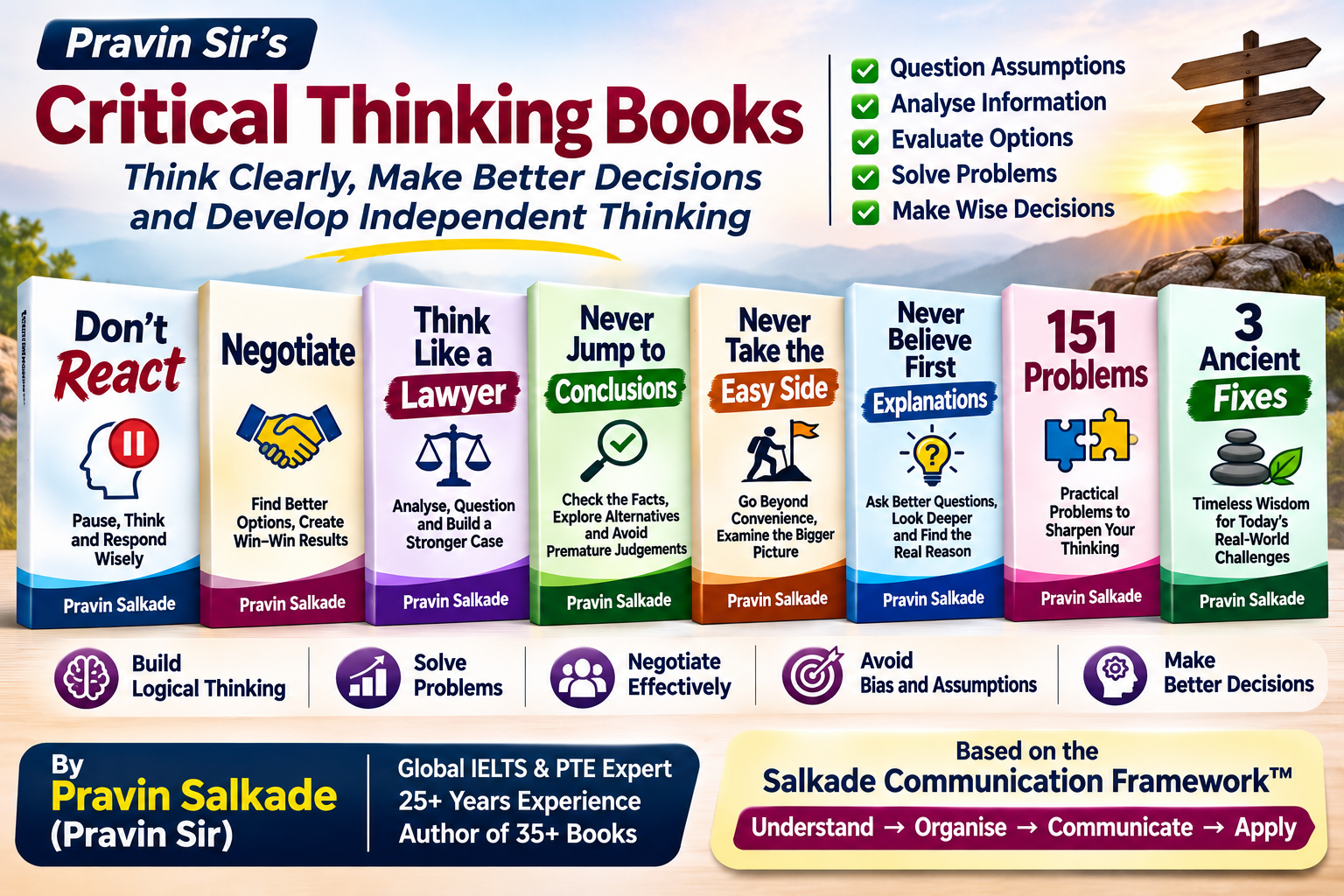
Q1. What does it actually mean to think like a lawyer?
Thinking like a lawyer does not simply mean knowing the law.
It means learning to examine information carefully before reaching a conclusion.
A lawyer typically asks:
What are the facts?
What evidence supports them?
What evidence contradicts them?
What assumptions are being made?
What alternative explanation is possible?
These habits are useful far beyond the courtroom.
Q2. Why should ordinary people learn to think like lawyers?
Everyday life involves decisions.
We evaluate news, advertisements, financial claims, social-media posts, business opportunities and other people's explanations.
The danger is that we often accept the first convincing explanation.
Legal-style thinking creates a pause between:
Information → Conclusion
That pause can improve decision-making.
Q3. What is the difference between a fact and an assumption?
A fact is something that can be supported by reliable evidence.
An assumption is something we accept without sufficient verification.
For example:
Fact: Sales declined by 20%.
Assumption: The sales decline happened because customers disliked the product.
The first statement may be supported by records.
The second requires investigation.
Confusing assumptions with facts is one of the most common reasoning errors.
Q4. How can people avoid jumping to conclusions?
Before reaching a conclusion, ask:
What do I actually know?
What am I assuming?
What evidence supports my conclusion?
What evidence could prove me wrong?
Is there another plausible explanation?
This creates intellectual discipline.
The goal is not to avoid conclusions.
It is to make conclusions earned rather than automatic.
Q5. Why is evidence more important than confidence?
A confident statement can still be wrong.
A person may speak with certainty because they have strong beliefs, not because they have strong evidence.
Good reasoning therefore separates:
Confidence from proof.
The stronger the claim, the stronger the evidence required to support it.
Q6. What is confirmation bias?
Confirmation bias is the tendency to notice information that supports what we already believe while ignoring information that challenges it.
For example, an investor who believes a particular asset will rise may pay attention to bullish news while dismissing negative evidence.
Thinking like a lawyer encourages us to ask:
What evidence would I expect to see if my belief were wrong?
That question can expose weaknesses in our reasoning.
Q7. How can the lawyer's approach improve everyday decision-making?
Consider a major decision.
Instead of asking:
What should I do?
first ask:
What are the facts?
Then separate:
Facts → Interpretations → Assumptions → Options → Risks → Decision
This structure makes complicated decisions easier to examine.
Q8. Does thinking like a lawyer mean becoming suspicious of everyone?
No.
The purpose is not constant suspicion.
It is disciplined verification.
Healthy reasoning means being willing to say:
I don't know yet.
That is often more intellectually honest than producing an immediate answer.
Q9. Can this framework help students and professionals?
Absolutely.
Students can use it to evaluate arguments and write stronger answers.
Professionals can use it to analyse problems, meetings and business decisions.
Entrepreneurs can use it to test assumptions.
Investors can use it to examine claims and risks.
In other words, legal-style reasoning is a transferable thinking skill.
Q10. What is the most important lesson from Think Like a Lawyer?
The central lesson is:
Don't believe the first explanation simply because it sounds convincing.
Separate facts from assumptions.
Examine evidence.
Consider alternative explanations.
Test your conclusion.
Then decide.
The objective is not to become a lawyer.
It is to become a better thinker.