Many English learners believe that speaking better English means learning more vocabulary, memorising more sentences and studying more grammar.
But there is another powerful approach:
Speak the scene.
Instead of starting with a sentence in your native language and translating it into English, start with what you can see, imagine or experience.
Then describe it.
What does 'Speak the Scene' mean?
Speak the Scene is a simple communication technique based on observation → thought → language.
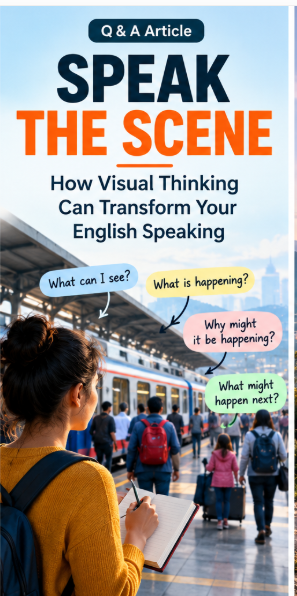
Imagine that you are standing at a railway station.
Instead of asking yourself:
“What is the English translation of what I want to say?”
Look at the scene.
You might notice:
A train is arriving.
People are waiting on the platform.
A child is holding his mother's hand.
Someone is checking the departure board.
A vendor is selling tea.
Now turn those observations into English.
You are no longer translating.
You are thinking through the scene.
Why does this technique help English learners?
Translation often creates a mental bottleneck.
The learner first thinks in the mother tongue, searches for the English equivalent, checks grammar, and then speaks.
That can make speaking slow and unnatural.
Scene-based speaking reduces some of that mental processing.
You see something.
You identify it.
You describe it.
Then you gradually learn to express opinions, explanations and stories directly in English.
How can you practise? Speak the scene every day?
Choose an ordinary scene.
It could be:
Your kitchen
A classroom
A marketplace
A bus stop
Your office
A photograph
A YouTube video
A street outside your home
Start with simple observations.
What can I see?
Then move to actions.
What is happening?
Then interpretation.
Why might it be happening?
Finally, prediction.
What might happen next?
This creates a natural progression from basic description to higher-level speaking.
Can Speak the Scene improve IELTS or PTE speaking?
It can be a useful practice method because many speaking tasks require learners to organise thoughts quickly and communicate clearly.
The objective should not be memorising model answers.
Instead, learners should practise generating language from ideas.
For example:
See: A crowded railway station.
Describe: The platform is crowded with passengers.
Explain: People may be travelling because of a festival.
Predict: The station will probably become even busier during the evening.
One scene can therefore generate dozens of sentences.
What is the deeper lesson of Speak the Scene?
Fluent speaking is not simply about knowing more English.
It is also about becoming faster at turning thoughts into English.
When learners stop treating English as a translation exercise and start treating it as a communication tool, speaking becomes more natural.
Don't always search for an English sentence.
Start with the scene—and let the sentence emerge from it.
That is the core idea behind Speak the Scene.