Q1. Why do students know the literature answer but still lose marks?
Knowing the story, poem or character is only one part of answering a literature question.
Examiners also look for:
Understanding
Interpretation
Evidence
Organisation
Explanation
Relevant language
A student may know everything about a novel but still lose marks if the answer becomes a plot summary instead of an analysis.
The key question is not only:
What happened?
It is:
What does it mean, and how can I prove my interpretation?
Q2. What is the difference between summarising and analysing literature?
A summary tells the reader what happened.
Analysis explains why it matters.
For example:
Summary:
The character refuses to accept the offer.
Analysis:
The character's refusal reveals a conflict between personal values and social expectations.
The second answer demonstrates interpretation rather than simple recall.
Q3. What framework can students use to build a strong literature answer?
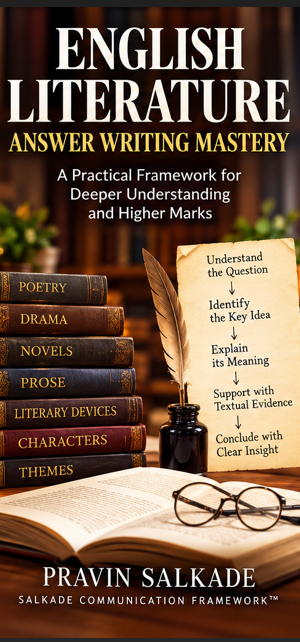
A practical framework can be built around five stages:
Understand → Identify → Explain → Support → Conclude
First understand the question.
Then identify the central idea, technique, character trait or theme.
Explain its significance.
Support the interpretation with relevant textual evidence.
Finally, connect the evidence back to the question.
This prevents answers from becoming disconnected collections of observations.
Q4. How should students begin a literature answer?
Students should avoid lengthy introductions that simply repeat the question.
A stronger opening directly establishes an interpretation.
For example:
Instead of:
The poem is about nature and the poet describes many aspects of nature.
write:
The poem presents nature not merely as a physical landscape but as a force that influences the speaker's emotions and perception.
The second opening immediately demonstrates interpretation.
Q5. How important is textual evidence?
Textual evidence is extremely important because it supports interpretation.
However, quotations should not be inserted simply to make an answer look academic.
The student should explain the significance of the evidence.
A useful sequence is:
Point → Evidence → Explanation → Link
The evidence becomes meaningful only when the student explains what it reveals.
Q6. How can students analyse literary devices?
Students should avoid merely naming devices.
For example:
The poet uses a metaphor.
This identifies the technique but does not analyse it.
A stronger response explains:
The metaphor presents the character's emotional state as something overwhelming, suggesting that the experience has changed the speaker's perception of the world.
The important question is:
What does the technique achieve?
Q7. How should students answer character-based questions?
A strong character answer should move beyond adjectives.
Instead of writing:
The character is brave.
students can explain:
The character's decision to act despite the consequences demonstrates courage, but it also reveals the character's willingness to sacrifice personal safety for a larger principle.
This creates a deeper interpretation.
Q8. How can students avoid writing irrelevant information?
Before writing each paragraph, students should ask:
Does this sentence help answer the question?
If the answer is no, the sentence may not belong in the response.
This simple test can dramatically improve relevance.
Q9. How can students make their literature answers more analytical?
Students should repeatedly use analytical questions:
Why?
How?
What does this reveal?
Why has the writer used this technique?
What effect does it create?
How does it connect to the theme?
What does it reveal about the character?
These questions push the response from description towards interpretation.
Q10. What is the central principle of the English Literature Answer Writing Framework?
The central principle is:
Don't just tell the examiner what the text says. Show the examiner what the text means.
A high-quality literature answer combines:
Understanding + Interpretation + Evidence + Explanation + Organisation
Once students understand this structure, literature answers become much more purposeful.
The goal is not to write more.
The goal is to make every paragraph do analytical work.