Grammar That Works Part 2: Questions for Learners Ask About English Grammar
English grammar does not have to be a collection of complicated rules. The real challenge is knowing which rule applies, why a sentence is wrong, and how to use the correct form naturally.
Grammar That Works Part 2 focuses on the mistakes learners actually make in speaking and writing.
Q1. Why do I know English grammar rules but still make mistakes?
Because knowing a rule and using it automatically are two different skills.
Many learners can explain that the third-person singular takes -s but still say 'He goes to work every day' while speaking.
The solution is repeated practice with meaningful sentences rather than memorising isolated rules.
Q2. What are the most common grammar mistakes made by English learners?
Common problems include:
- Incorrect verb forms
- Wrong use of articles
- Subject–verb agreement errors
- Incorrect prepositions
- Confusion between tenses
- Double negatives
- Incorrect word order
- Missing auxiliary verbs
- Confusion between adjectives and adverbs
The important question is not simply, 'What is wrong?' But why is it wrong?
Q3. How can I improve my grammar without memorising hundreds of rules?
Start with the errors you personally make most often.
Take one mistake, understand the pattern, create five correct examples and deliberately use the structure in conversation or writing.
Grammar improves faster when it becomes a habit of accurate communication.
Q4. Why are small grammar mistakes important in IELTS and PTE?
A single mistake may not destroy a score, but frequent errors can affect the impression of grammatical control.
In examinations such as IELTS and PTE, accuracy matters alongside vocabulary, fluency, coherence and task achievement.
The goal should therefore be clear, controlled English, not unnecessarily complicated English.
Q5. What is the best way to correct repeated grammar mistakes?
Keep an error notebook.
For every repeated mistake, record:
Wrong sentence → Correct sentence → Reason → Your own example
This turns correction into learning.
Q6. Can grammar improvement help spoken English?
Yes. Good grammar makes it easier to express ideas accurately.
However, spoken English should not become a grammar examination. The objective is to develop enough grammatical control that correct structures begin to appear naturally during conversation.
Q7. Why do Indian English learners often struggle with articles and prepositions?
Languages influence the way we construct sentences in English. Learners may transfer patterns from their first language into English.
Instead of translating word-for-word, learn common English expressions as complete patterns.
For example:
interested in, good at, afraid of, depend on
are better learned as combinations than as isolated words.
Q8. Is complicated grammar necessary for a high English score?
No.
A well-controlled simple sentence is usually better than a complicated sentence containing several errors.
Strong English is not about showing how many grammatical structures you know. It is about using the right structure at the right time.
Q9. How can I make grammar practice more practical?
Use grammar in real situations.
Describe your morning routine. Explain your opinion. Talk about your work. Describe yesterday's experience. Discuss your plans for next month.
When grammar is connected to communication, it becomes easier to remember.
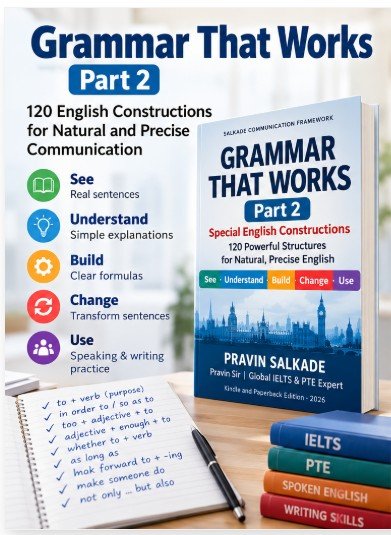
Q10. Who can benefit from Grammar That Works Part 2?
The book can help students, spoken-English learners, IELTS and PTE candidates, teachers and anyone who wants to make fewer grammar mistakes in everyday communication.
Grammar works best when you use it—not when you merely study it.