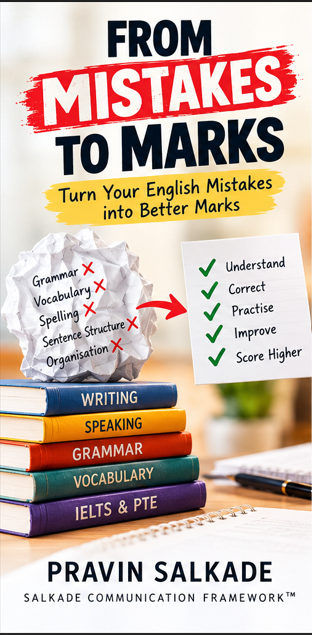
Q1. Why do students make the same English mistakes again and again?
Students often repeat the same mistakes because they focus on the answer rather than the reason behind the mistake.
For example, a student may learn that a particular sentence is incorrect, but if they do not understand why it is incorrect, the same grammatical pattern may appear again in their next writing or speaking task.
The real improvement begins when students stop asking only:
What is the correct answer?
and start asking:
Why did I make this mistake?
This shift turns mistakes into learning opportunities.
Q2. Can English mistakes actually help students improve their marks?
Yes. A mistake can reveal a specific weakness in grammar, vocabulary, sentence structure, organisation or comprehension.
Instead of treating mistakes as failures, students can classify them.
For example:
Grammar mistake
Vocabulary mistake
Spelling mistake
Sentence-formation mistake
Pronunciation mistake
Organisation mistake
Misunderstanding of the question
Once mistakes are classified, students can work on the underlying problem instead of randomly practising English.
Q3. What is the biggest mistake students make while improving English?
One of the biggest mistakes is trying to improve everything simultaneously.
Students often jump from grammar exercises to vocabulary lists, then to speaking practice, then to essay writing, without identifying their most important weaknesses.
A better approach is:
Identify → Understand → Correct → Practise → Use
This creates a feedback loop in which every mistake becomes useful information.
Q4. How can students create a personal mistake notebook?
A mistake notebook does not need to contain hundreds of pages.
Students can create five columns:
My mistake | Correct version | Why it is wrong | Rule/pattern | My new example
For example:
Mistake: He goes to school every day.
Correction: He goes to school every day.
Reason: Third-person singular takes the appropriate present-tense form.
New example: She works in Mumbai.
The important part is creating a new example. That forces the learner to use the correction rather than simply memorising it.
Q5. Why is correcting mistakes better than simply memorising grammar rules?
Grammar rules become useful when learners can apply them.
A student may know the rule for articles, tenses or subject-verb agreement but still make mistakes while speaking or writing.
Mistake-based learning connects:
Rule → Error → Correction → Application
That makes grammar practical rather than theoretical.
Q6. How does this approach help IELTS and PTE students?
IELTS and PTE candidates need more than knowledge of English.
They need to demonstrate their English under examination conditions.
A candidate who repeatedly analyses their mistakes can identify patterns in their writing, speaking, reading and listening performance.
For example, if a student repeatedly loses marks because of sentence structure, simply learning more vocabulary may not solve the problem.
The student needs targeted practice.
Q7. What is the From Mistakes to Marks approach?
The central idea is simple:
Don't waste your mistakes. Study them.
Every mistake should answer three questions:
What went wrong?
Why did it go wrong?
What will I do differently next time?
This transforms correction into a learning system.
Q8. Can this method help students become independent learners?
Yes.
The ultimate goal of learning is not to depend permanently on a teacher.
When students can identify, classify and correct their own mistakes, they develop self-monitoring skills.
That is one of the most valuable skills in language learning.
Q9. Why do some students practise a lot but improve very slowly?
Practice alone does not guarantee improvement.
If a student repeatedly practises the same weakness without analysing it, they may simply repeat the same mistakes.
Effective practice requires feedback.
A useful formula is:
Practice + Feedback + Correction + Repraise = Improvement
Q10. What is the biggest lesson of From Mistakes to Marks?
The biggest lesson is that mistakes do not have to remain evidence of weakness.
They can become evidence of learning.
Instead of thinking:
I made a mistake, so I am bad at English.
Students should think:
I found a weakness, so now I know what to improve.
That change in mindset can turn mistakes into marks.