How Can Schools Improve Students' English Writing, Literature Skills and Spoken Communication? Explore Four Practical Books by Pravin Salkade
A practical resource collection for CBSE, ICSE, Cambridge, IB and other global school systems
English proficiency is no longer limited to scoring well in school examinations. Students need to express ideas clearly, write effectively, understand literature, participate confidently in discussions and communicate naturally in everyday situations.
For schools, this creates an important responsibility: developing students who can use English confidently, not merely study it as an academic subject.
But how can schools strengthen these abilities? What resources can teachers use? And how can principals and school management teams introduce more structured approaches to English language development?
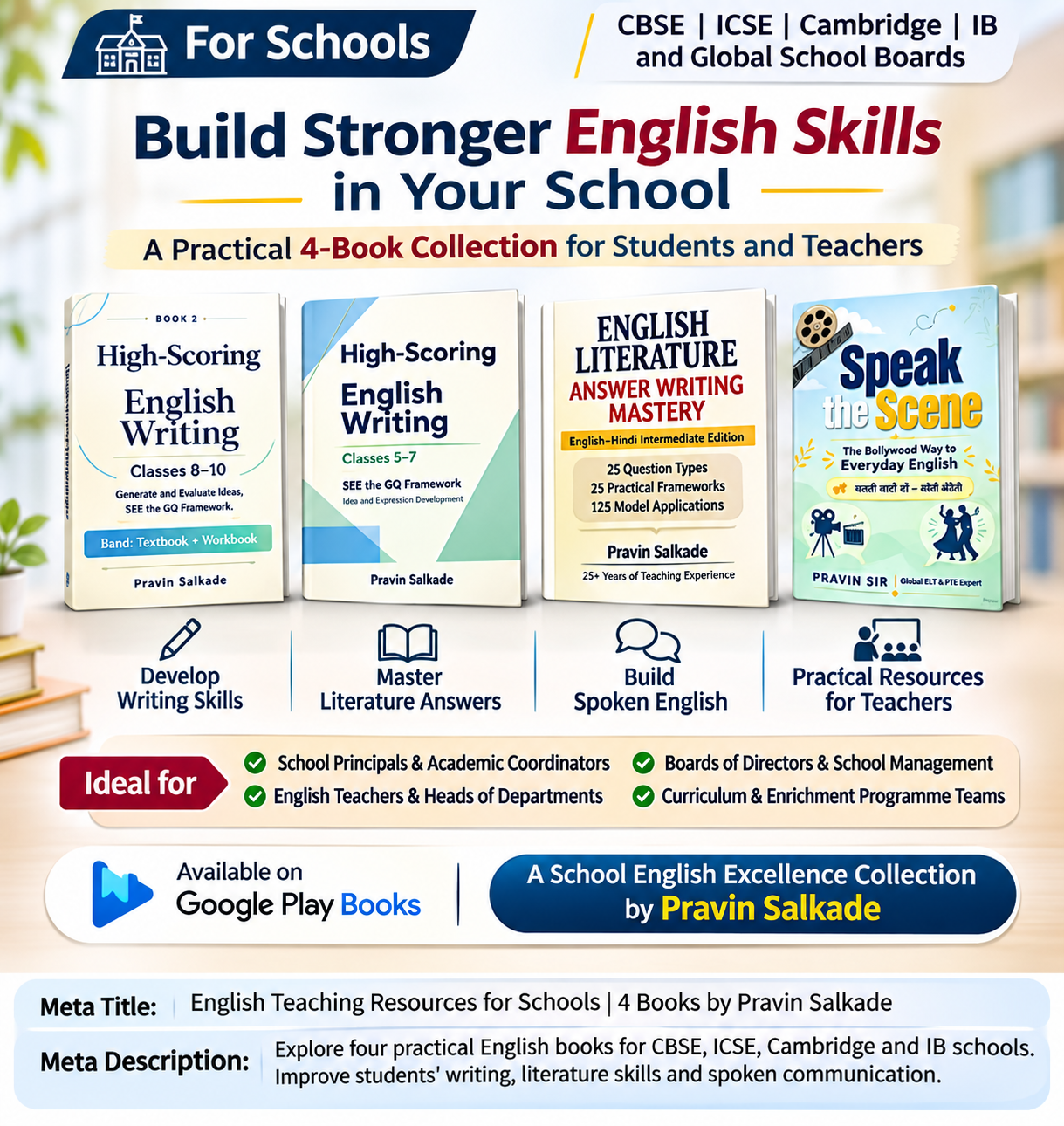
The four-book school collection by Pravin Salkade, creator of the Salkade Communication Framework™, offers practical resources addressing different dimensions of English learning.
This article explores how these books can support students, teachers and school leadership teams.
1. Why should schools go beyond conventional English teaching?
Traditional English teaching often focuses heavily on textbooks, grammar exercises, comprehension passages and examination preparation.
These remain important, but students also need opportunities to:
- Generate and organise ideas before writing.
- Develop structured and meaningful answers.
- Express their understanding of literature.
- Build vocabulary through practical contexts.
- Speak confidently in everyday situations.
- Develop independent thinking and communication skills.
Schools that integrate these abilities into regular teaching can create richer English learning experiences.
2. What are the four books that schools should explore?
The collection includes four complementary resources.
Book 1: High-Scoring English Writing – Classes 8–10
Writing is one of the most important skills assessed in school English examinations.
However, many students struggle with generating ideas, organising information and presenting their thoughts coherently.
This book introduces the SEE the GQ Framework to help students generate and evaluate ideas and develop stronger written responses.
How can teachers use this book?
- Teach students to generate relevant ideas.
- Help them organise their thoughts before writing.
- Develop structured responses.
- Improve clarity and coherence.
- Conduct guided writing exercises.
- Encourage independent writing practice.
Institutional benefit: Schools can use it as a supplementary resource for developing writing proficiency among middle and secondary school students.
Book 2: High-Scoring English Writing – Classes 5–7
The foundation of effective writing should be developed early.
Students in Classes 5–7 need opportunities to organise ideas, express themselves and gradually develop confidence in written English.
This book introduces structured writing development using the SEE the GQ Framework.
How can teachers use this book?
- Introduce age-appropriate writing activities.
- Encourage students to think before writing.
- Develop idea-generation skills.
- Improve sentence and paragraph organisation.
- Conduct individual and classroom writing exercises.
Institutional benefit: Schools can introduce structured writing practice before students enter higher classes, helping them develop stronger foundations.
Book 3: English Literature Answer Writing Mastery
Understanding a poem, story or literary passage is only one part of studying literature. Students must also learn to communicate their understanding through well-developed answers.
Many students understand the lesson but struggle to write meaningful, organised and relevant examination responses.
This book focuses on English literature answer-writing skills through question types, practical frameworks and model applications.
How can teachers use this book?
- Teach students to understand different question types.
- Develop structured literature answers.
- Improve interpretation and explanation.
- Encourage students to support their responses with relevant details.
- Conduct answer-writing and evaluation activities.
Institutional benefit: Teachers can use it as supplementary material for improving students' literary understanding and written expression.
Book 4: Speak the Scene – The Bollywood Way to Everyday English
Students may study English for years without becoming comfortable using it in everyday conversations.
This book uses familiar cinematic situations and scene-based learning to introduce practical English communication.
It offers an opportunity to connect language learning with situations students can recognise and discuss.
How can teachers use this book?
- Organise role-play activities.
- Conduct dialogue-based classroom exercises.
- Encourage students to speak in everyday situations.
- Develop conversational vocabulary.
- Practise pronunciation, fluency and natural expressions.
- Conduct pair and group speaking activities.
Institutional benefit: Schools can use it as supplementary material for spoken English activities, language clubs and communication development programmes.
3. How can these four books support CBSE schools?
CBSE schools aim to develop academic proficiency alongside broader student competencies.
The four books address complementary areas:
Book| School learning application
High-Scoring English Writing – Classes 5–7| Foundational writing
High-Scoring English Writing – Classes 8–10| Structured and advanced writing
English Literature Answer Writing Mastery| Literature comprehension and answers
Speak the Scene| Everyday spoken communication
Schools can explore these resources as supplementary material alongside their prescribed textbooks and existing academic programmes.
The books are not presented as officially approved CBSE textbooks or replacements for prescribed curriculum material.
4. Are these books relevant to Cambridge, IB and international schools?
Yes. The underlying learning objectives are relevant across different educational systems.
Students studying in international school environments also need to develop:
- Clear written communication.
- Critical and independent thinking.
- Interpretation of literary texts.
- Structured expression of ideas.
- Confidence in spoken English.
- Effective participation in discussions.
Teachers can adapt the activities to their respective curricula, age groups and learning objectives.
The books should be considered supplementary resources rather than substitutes for Cambridge, IB or other prescribed curricula.
5. How can principals introduce these resources into school programmes?
School principals and academic coordinators can explore several practical approaches.
Option 1: Writing development programme
Introduce structured writing activities using the two High-Scoring English Writing books.
Option 2: Literature answer-writing workshops
Organise focused sessions using English Literature Answer Writing Mastery.
Option 3: Spoken English enrichment
Use Speak the Scene for role plays, conversations and classroom speaking activities.
Option 4: Integrated English development programme
Combine all four resources to address writing, literature and spoken communication.
The school can begin with a pilot programme involving selected classes before considering wider implementation.
6. How can English teachers benefit from these books?
Teachers need more than theoretical knowledge. They need practical ways to explain concepts, organise activities and assess student progress.
These books can help teachers:
- Introduce structured writing exercises.
- Develop individual and group activities.
- Encourage students to think independently.
- Create classroom discussions.
- Design practice assignments.
- Identify areas where students need additional support.
They can also provide ideas for English language enrichment programmes and teacher-led workshops.
7. Why should school management and boards of directors consider English communication development?
English proficiency influences students' ability to participate in higher education, professional environments and international communication.
School management teams can consider English development as a long-term institutional priority.
Investing in structured writing, literature and communication activities can complement existing academic programmes.
The four-book collection provides a possible starting point for schools interested in strengthening these areas through practical supplementary resources.
8. Can schools use these books for teacher training?
Yes. Teachers can explore the frameworks and activities in the books and discuss how to adapt them to their classrooms.
Possible professional development activities include:
- Demonstrating structured writing lessons.
- Sharing methods of teaching idea generation.
- Discussing effective literature answer evaluation.
- Conducting role-play demonstrations.
- Designing classroom activities around everyday communication.
Schools can also organise internal workshops where teachers develop lesson plans based on the books.
9. Who should explore this four-book collection?
The collection is particularly relevant to:
1. CBSE school principals and academic coordinators.
2. ICSE school management teams.
3. Cambridge and IB school educators.
4. Boards of directors of educational institutions.
5. Heads of English departments.
6. English language teachers.
7. School curriculum planners.
8. Teachers interested in practical classroom resources.
10. Where can schools explore the books?
The four titles are available through Google Play Books.
Schools, teachers and parents can explore the individual books and assess their suitability for their students and institutional requirements.
Author: Pravin Salkade
English Language Educator | Author | Creator of the Salkade Communication Framework™
With a focus on helping learners understand, organise, communicate and apply knowledge, the collection reflects a practical approach to English language development.
Explore more educational resources and articles:
https://www.pravinsalkade.com/articles
Final Thoughts: Develop Students Who Can Think, Write and Communicate
A student's English education should not end with the ability to answer textbook questions.
Students should gradually develop the ability to generate ideas, organise information, interpret literature and communicate confidently.
The four books by Pravin Salkade offer schools supplementary resources to address these important dimensions of English learning.
For principals, academic coordinators, boards of directors and English teachers, this is an opportunity to explore practical resources that can complement existing school programmes and strengthen students' English development.