How Can Critical Thinking Improve Relationships, Friendships and Career Success? Six Books That Can Change the Way You Think and Live
Why do relationships break down? Why do friendships sometimes turn into misunderstandings? Why do capable professionals make poor career decisions? Why do people believe the first explanation, jump to conclusions or choose the easiest option without examining the consequences?
Many problems in life are not caused by a lack of intelligence. They arise from the way we interpret situations, respond to people, evaluate information and make decisions.
A misunderstood conversation can damage a friendship. An emotional reaction can weaken a relationship. A premature conclusion can destroy trust. An impulsive response can affect a professional opportunity. Choosing the easy option repeatedly can prevent personal growth.
What if we could improve these situations by learning to think differently?
Critical thinking is not merely an academic skill. It is a life skill that influences relationships, friendships, professional decisions, leadership, negotiation and personal growth.
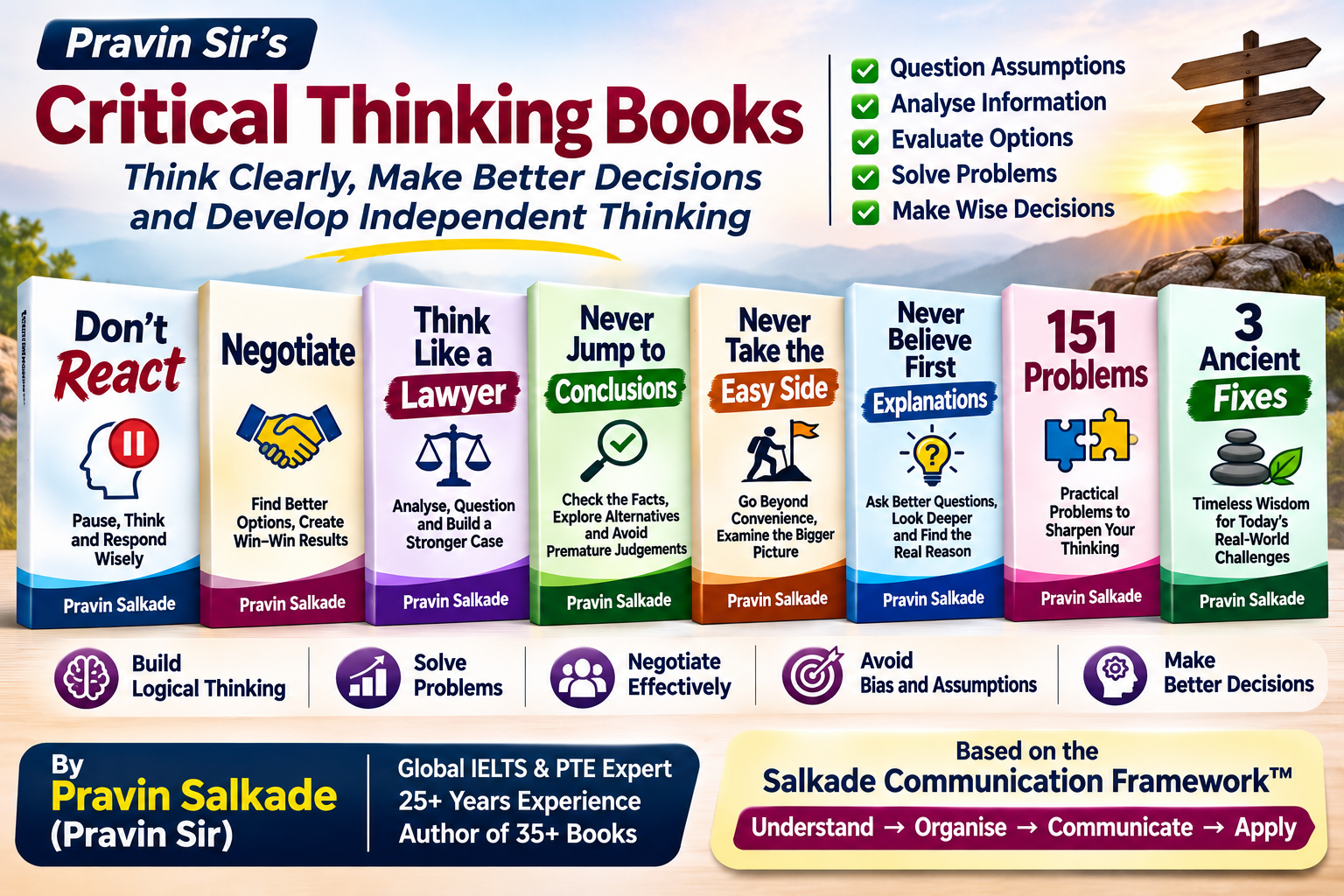
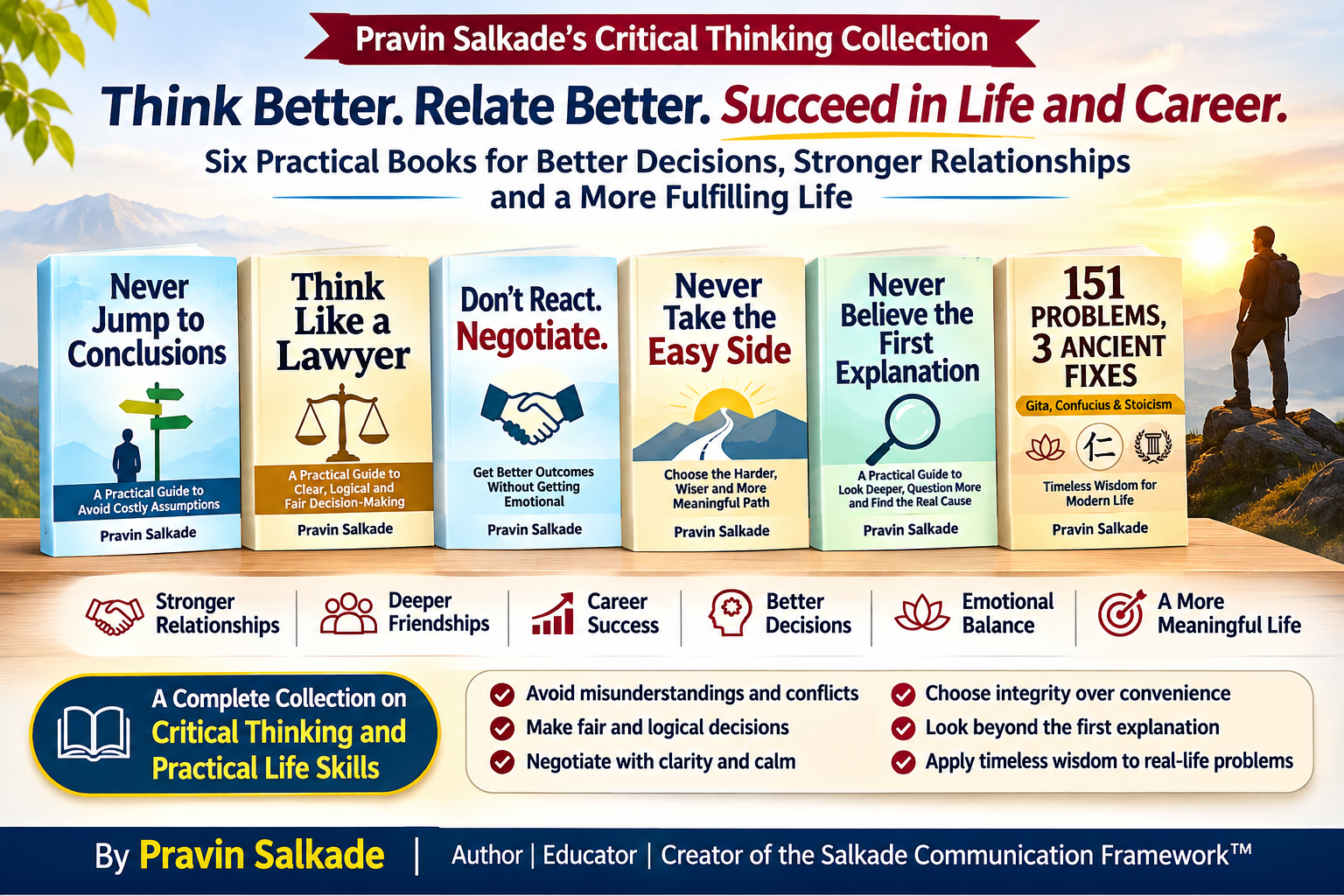
The six books by Pravin Salkade, built around practical thinking and decision-making principles, explore different dimensions of this challenge.
They encourage readers to question assumptions, examine evidence, consider alternative explanations, manage emotional reactions and make more thoughtful decisions.
Let's explore how these ideas can influence everyday life.
1. Why is critical thinking important in everyday life?
Most people make dozens of decisions every day.
Some are insignificant. Others influence relationships, careers, finances and long-term opportunities.
Consider these situations:
- A friend does not reply to your message. You assume that the person is ignoring you.
- A colleague disagrees with your suggestion. You interpret the disagreement as personal hostility.
- Your partner behaves differently. You immediately suspect something is wrong.
- Your manager gives you critical feedback. You react defensively instead of examining the feedback.
- Someone presents a convincing explanation. You accept it without checking the facts.
In each situation, the problem may not be the event itself. It may be the interpretation.
Critical thinking teaches us to distinguish between what happened, what we believe happened and what we actually know.
This distinction can prevent unnecessary conflict and improve decision-making.
2. How can critical thinking strengthen personal relationships?
Strong relationships depend on communication, understanding, trust and emotional maturity.
However, people frequently interpret situations without having sufficient information.
For example, imagine that your partner arrives home later than expected.
You immediately conclude that the person does not value your time.
But there could be several explanations: unexpected work, traffic, an emergency or a communication failure.
A premature conclusion may lead to an unnecessary argument.
A thoughtful response would involve asking questions, listening and understanding the situation before reacting.
Critical thinking can help people:
- Avoid unnecessary assumptions.
- Separate facts from interpretations.
- Understand different perspectives.
- Ask meaningful questions.
- Respond instead of reacting.
- Resolve disagreements more constructively.
It does not mean tolerating dishonesty or ignoring genuine problems. It means understanding a situation before deciding how to respond.
3. How can critical thinking improve friendships?
Friendships often deteriorate because of expectations, misunderstandings and unspoken assumptions.
Consider a friend who declines an invitation.
One person may interpret the refusal as rejection. Another may understand that the friend has personal commitments.
The difference lies in interpretation.
A thoughtful person does not immediately convert one incident into a judgment about an entire friendship.
Instead, the person considers the broader relationship, communicates openly and avoids making permanent judgments based on temporary situations.
Critical thinking helps us recognise that:
- One disagreement does not necessarily end a friendship.
- Different opinions do not automatically indicate disrespect.
- Silence does not always mean rejection.
- A mistake does not always reveal someone's character.
- Trust should be based on patterns of behaviour, not isolated assumptions.
Strong friendships require both emotional connection and thoughtful understanding.
4. Why should we never jump to conclusions?
Book: Never Jump to Conclusions
One of the most damaging habits in human interaction is reaching a conclusion before examining the available information.
People frequently confuse assumptions with facts.
For example:
Your colleague does not greet you in the morning.
You conclude that the colleague is upset with you.
You begin avoiding the person. The colleague notices the change and also becomes uncomfortable.
An ordinary misunderstanding gradually becomes a relationship problem.
What could have prevented it?
A simple question.
Are you okay? You seemed a little distracted today.
The lesson is important: do not allow an unverified interpretation to become the foundation of your behaviour.
This principle applies to:
- Marriage and family relationships.
- Friendships.
- Workplace communication.
- Customer relationships.
- Leadership decisions.
- Business partnerships.
Learning to pause before reaching conclusions can protect valuable relationships.
5. Why should we never believe the first explanation?
Book: Never Believe the First Explanation
The first explanation is not necessarily the complete explanation.
People sometimes provide incomplete information. Others may misunderstand a situation themselves. Some explanations are influenced by personal interests, assumptions or limited knowledge.
Consider a workplace example.
A project misses its deadline.
The first explanation is that one team member failed to complete the assigned task.
But further investigation reveals that the project requirements changed, communication was delayed and the team did not receive the necessary information.
Blaming one individual would have hidden the actual problem.
This book's central thinking principle is particularly relevant when:
- Evaluating workplace problems.
- Understanding disagreements.
- Making professional decisions.
- Assessing business proposals.
- Examining conflicting information.
- Resolving misunderstandings.
The ability to examine alternative explanations can lead to fairer judgments and better decisions.
6. How can thinking like a lawyer improve decision-making?
Book: Think Like a Lawyer
Thinking like a lawyer does not mean arguing with everyone.
It means learning to examine claims, question assumptions, evaluate evidence and consider different interpretations before reaching a conclusion.
Imagine that a business partner makes a proposal that appears attractive.
Instead of accepting it immediately, you ask:
- What evidence supports this proposal?
- What assumptions are being made?
- What information is missing?
- What could go wrong?
- What would the other party say?
- What are the long-term consequences?
This approach can improve decision-making in professional and personal situations.
It is particularly useful for:
- Entrepreneurs evaluating business opportunities.
- Managers making organisational decisions.
- Professionals handling workplace disagreements.
- Parents making important family decisions.
- Students evaluating arguments and information.
- Individuals entering financial or contractual commitments.
Thinking carefully before deciding is not indecision. It is responsible judgment.
7. How can we negotiate without damaging relationships?
Book: Don't React. Negotiate.
Negotiation is part of everyday life.
We negotiate salaries, responsibilities, deadlines, business terms, family arrangements and expectations.
Yet many negotiations fail because people become emotionally involved.
Imagine that your manager rejects your request for a salary increase.
You feel disappointed and respond angrily.
The discussion becomes personal, and the opportunity for a constructive conversation disappears.
A more effective approach would be to understand the reasons behind the decision, present your contribution and discuss what would be required to reconsider the request.
The principle is simple:
Do not allow an emotional reaction to replace a thoughtful negotiation.
This book's message is relevant to:
- Salary negotiations.
- Workplace disagreements.
- Business partnerships.
- Customer conversations.
- Family discussions.
- Professional networking.
- Conflict resolution.
Negotiating effectively does not mean winning every argument. It means working towards better outcomes while preserving professional respect and, where possible, the relationship.
8. Why should we avoid taking the easy side?
Book: Never Take the Easy Side
People often choose the easiest option because it requires less effort, less questioning and less immediate discomfort.
But the easiest option is not always the wisest.
Consider a workplace situation.
A team member makes a mistake. Everyone blames that individual because it is convenient.
Nobody investigates the process, communication failures or management decisions that contributed to the problem.
The organisation avoids an uncomfortable discussion but learns nothing.
Similarly, in personal relationships, agreeing with someone simply to avoid disagreement may create temporary peace but leave important issues unresolved.
This book encourages readers to examine difficult choices rather than automatically following the path of least resistance.
It is relevant to:
- Ethical decision-making.
- Leadership and accountability.
- Personal discipline.
- Career development.
- Professional integrity.
- Long-term relationships.
Growth often begins when we are willing to examine uncomfortable questions.
9. What can ancient philosophies teach us about modern problems?
Book: 151 Problems, 3 Ancient Fixes: Gita, Confucius & Stoicism
Modern life presents problems that often appear new.
However, many underlying human challenges have existed for centuries.
People have always struggled with anger, expectations, ambition, relationships, responsibilities, uncertainty and difficult decisions.
This book brings together three important philosophical traditions:
- The Bhagavad Gita.
- Confucian thought.
- Stoicism.
These traditions offer different perspectives on human behaviour, responsibility, self-control and thoughtful living.
Their ideas can encourage readers to examine questions such as:
- How should we respond to situations beyond our control?
- How can we manage our reactions?
- What responsibilities do we have towards others?
- How should we balance personal ambition and ethical conduct?
- How can we make difficult decisions without losing our judgment?
- How can we remain composed during uncertainty?
The value of ancient philosophy is not simply in knowing what great thinkers said.
It lies in examining how their ideas can help us approach contemporary problems.
10. How can these six books contribute to career success?
Career success requires more than technical knowledge.
Professionals also need judgment, communication skills, emotional maturity, negotiation abilities and the capacity to solve problems.
Consider six professional situations:
Workplace challenge| Relevant book
Misunderstanding a colleague| Never Jump to Conclusions
Accepting an incomplete explanation| Never Believe the First Explanation
Evaluating a proposal| Think Like a Lawyer
Handling a disagreement| Don't React. Negotiate.
Taking an ethical decision| Never Take the Easy Side
Managing complex personal and professional challenges| 151 Problems, 3 Ancient Fixes: Gita, Confucius & Stoicism
Together, these books address thinking habits that can influence professional judgment and workplace relationships.
They can be particularly relevant to managers, team leaders, entrepreneurs, consultants, educators and young professionals.
11. Can these books help parents and teachers?
Parents and teachers influence how young people think, communicate and make decisions.
Instead of simply telling children what to think, adults can encourage them to examine situations independently.
For example:
- Ask children what evidence supports their conclusion.
- Encourage them to consider alternative explanations.
- Discuss the consequences of different decisions.
- Teach them to disagree respectfully.
- Help them distinguish between facts and opinions.
- Encourage them to take responsibility for their choices.
These practices can contribute to better communication and independent thinking.
The six books can be explored as supplementary reading resources for adults interested in developing these abilities in themselves and encouraging thoughtful discussion with young people.
12. Can critical thinking improve marriage and family relationships?
Yes, although critical thinking alone cannot guarantee a successful relationship.
Healthy relationships also require affection, trust, empathy, respect and consistent effort.
However, thoughtful judgment can help people avoid several common mistakes.
For example:
- Assuming that a disagreement means a lack of love.
- Treating one mistake as proof of someone's character.
- Reacting emotionally without understanding the situation.
- Refusing to consider another person's perspective.
- Avoiding difficult conversations merely to maintain temporary peace.
The ability to pause, ask questions and understand different perspectives can make communication more constructive.
13. Why should entrepreneurs and business leaders read these books?
Entrepreneurs frequently make decisions under uncertainty.
They evaluate opportunities, negotiate agreements, manage employees, resolve disagreements and respond to unexpected problems.
Poor judgment can be expensive.
A business leader who accepts the first explanation may miss the actual cause of a problem.
A manager who reacts emotionally may damage team morale.
An entrepreneur who takes the easiest option may compromise long-term business interests.
These six books explore thinking approaches that can complement professional experience and business knowledge.
They are relevant to anyone who wants to become a more thoughtful decision-maker.
14. Do these books teach people to become argumentative?
No. The objective of critical thinking should not be to win every disagreement.
It should be to understand situations more accurately, make better decisions and communicate more responsibly.
There is an important difference between being argumentative and being thoughtful.
An argumentative person wants to prove that others are wrong.
A thoughtful person wants to understand what is right, what is reasonable and what is supported by evidence.
The goal is not to create conflict. It is to prevent unnecessary conflict and handle genuine disagreements more constructively.
15. What is the common philosophy connecting all six books?
Although the six books examine different situations, they share a common theme: the quality of our decisions depends on the quality of our thinking.
Their connected principles can be expressed through six habits:
1. Pause before reaching a conclusion.
2. Question the first explanation.
3. Examine evidence and alternative perspectives.
4. Avoid emotional reactions during important discussions.
5. Choose integrity over convenience.
6. Learn from established philosophical wisdom.
These habits can influence how we build relationships, manage friendships, handle professional challenges and approach life's uncertainties.
Final Thoughts: Better Thinking, Better Relationships, Better Decisions and Better Lives
We often invest considerable time in developing professional qualifications, technical knowledge and career skills.
But how much time do we spend improving the way we think?
How often do we examine our assumptions? How frequently do we question our first interpretation? How effectively do we handle disagreements? How often do we choose long-term wisdom over short-term convenience?
These questions matter because our thinking influences our behaviour, and our behaviour influences our relationships, opportunities and decisions.
The six books by Pravin Salkade explore these interconnected aspects of life.
Whether you are a student, parent, teacher, professional, entrepreneur or leader, developing better thinking habits can help you approach everyday challenges with greater clarity and responsibility.
You cannot control every situation, every person or every outcome. But you can improve the way you interpret situations, respond to people and make decisions.
That is where better thinking begins.
Explore the Six Books
1. Never Jump to Conclusions
2. Never Believe the First Explanation
3. Think Like a Lawyer
4. Don't React. Negotiate.
5. Never Take the Easy Side
6. 151 Problems, 3 Ancient Fixes: Gita, Confucius & Stoicism
Explore these books by Pravin Salkade on Amazon and Google Play Books.
Author: Pravin Salkade
Author | English Language Educator | Creator of the Salkade Communication Framework™
Explore more articles and educational resources:
https://www.pravinsalkade.com/articles
Think Clearly → Communicate Naturally → Decide Wisely.